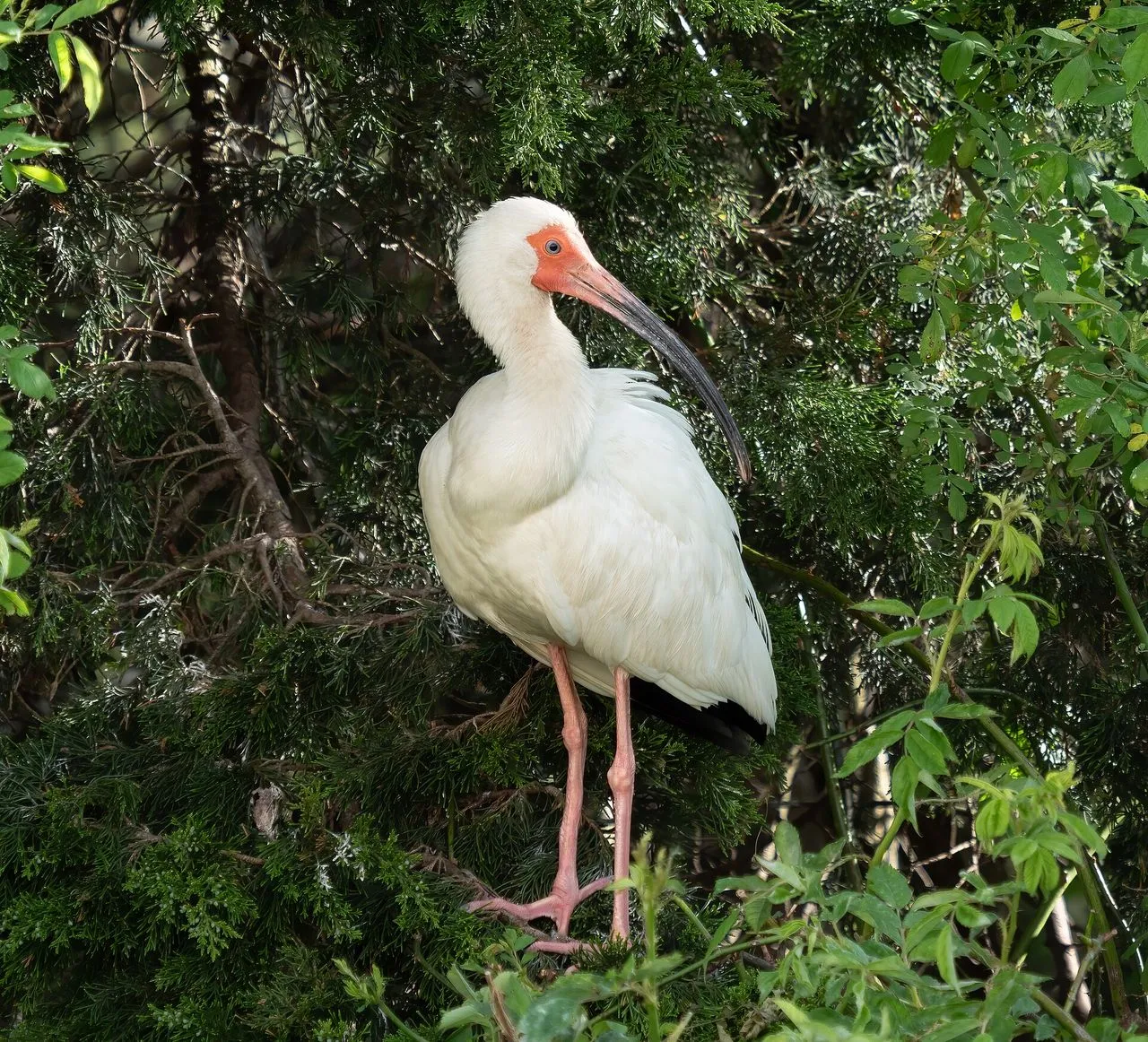
Eudocimus albus (Linnaeus, 1758), the White Ibis, is the common white, red-billed ibis of the southeastern United States, probing by touch in flocks that can number from a dozen birds to several thousand.
Part of the Complete Waders & Herons Guide.
Identification at a glance
| Character | White Ibis (Eudocimus albus) | Glossy Ibis (Plegadis falcinellus) | Roseate Spoonbill (Platalea ajaja) |
|---|---|---|---|
| Length | 56–71 cm (22–28 in) | 48–66 cm (19–26 in) | 71–86 cm (28–34 in) |
| Adult body | White with black wingtips | Dark chestnut and iridescent | Pink |
| Bill | Red-orange, decurved | Dark, decurved | Flattened, spatulate |
| Juvenile | Brown above, white below | Darker brown with fine head streaking | Pale, feathered head |
| Feeding | Tactile probing | Tactile probing | Tactile sweeping |
Identification
Visual
Adults are 56–71 cm, white-bodied, with black wingtips visible in flight, a long red-orange decurved bill, and red-orange legs. Bare facial skin is the same red-orange tone as the bill. The body is not egret-shaped: the neck is extended in flight, the bill curves downward, and the bird often walks with a horizontal probing posture.
Juveniles are brown above and white below, with a duller pinkish bill and legs. During the second year they become mottled brown and white before attaining full adult plumage. Immature birds in mixed flocks are common and should not be misread as separate species.
The white adult is most often confused by beginners with egrets. The bill resolves it immediately. No North American egret has a long red decurved bill. In flight, White Ibis alternates flapping and gliding more often than herons and keeps the neck extended rather than folded.
Audio
White Ibises give nasal grunts and honking croaks, especially in flight flocks and colonies. Feeding flocks are not silent, but sound is secondary to the visual pattern of white birds walking in loose lines across marsh or lawn.
Distribution
The species breeds along the Atlantic and Gulf coasts of the United States, through Florida, the Caribbean, Mexico, Central America, and northern South America. In the United States it is most abundant in Florida, coastal Georgia and South Carolina, Louisiana, and Texas.
Post-breeding dispersal carries birds inland and northward, sometimes well beyond regular breeding range. Urban and suburban use has increased in parts of the Southeast, where ibises feed on lawns, golf courses, stormwater ponds, and landfill edges. Long-term abundance in natural wetlands still depends on hydrological cycles, especially in the Everglades.
Habitat
White Ibises use freshwater marshes, wet prairies, mangrove edges, saltmarshes, tidal flats, flooded fields, cypress swamps, and urban lawns. They require shallow water or soft ground for probing. The species is comfortable in both fresh and brackish settings, but prey composition changes with salinity.
Nesting colonies are usually in shrubs, mangroves, or trees over water or on islands. Foraging sites may be many kilometres from the colony. Large morning flights from roosts and colonies are a familiar feature of coastal southeastern wetlands.
Diet and Foraging
The bill is used as a tactile instrument. White Ibises walk steadily, probing mud, grass, or shallow water with the bill partly open. When prey contacts the bill, the mandibles close rapidly. Crayfish are important in freshwater systems; fiddler crabs, small crabs, aquatic insects, worms, frogs, snails, and small fish are also taken.
Because they detect prey by touch, White Ibises can feed effectively in muddy water where herons relying on sight are disadvantaged. Flocks often move in coordinated fronts, each bird probing a small strip. Individuals may steal prey from one another, and juveniles are less efficient than adults.
In urban lawns, ibises probe for soil invertebrates. This behaviour is natural in mechanism but occurs in artificial habitat. Feeding by people is harmful: bread and processed food alter behaviour and provide poor nutrition, particularly for young birds learning normal foraging.
Breeding Biology
White Ibises are colonial nesters, often in very large colonies with herons, egrets, spoonbills, and cormorants. Nesting can be highly synchronized after favourable water conditions. In the Everglades, reproductive success historically tracked seasonal drying, which concentrated crayfish and fish in accessible pools during chick provisioning.
The nest is a platform of sticks or reeds placed in shrubs, mangroves, or low trees. Clutch size is commonly two to four eggs. Incubation lasts about 21 days. Both sexes incubate and feed young by regurgitation. Chicks leave the nest platform before they can fly and move through colony vegetation.
Water level is the central breeding variable. Too much water disperses prey; too little water exposes colonies to raccoons and other predators. The species is therefore a useful biological indicator of wetland management, not merely a beneficiary of any wet ground.
Notes
White Ibis flocks are among the easiest wader groups for beginners to identify, but their ecology is not simple. The bird's success depends on a precise match between water depth, substrate softness, prey density, and colony safety.
Hybridisation with Scarlet Ibis (Eudocimus ruber) occurs where the species meet or where escaped Scarlet Ibises have entered feral populations. In the ordinary North American field context, however, a white adult ibis with red bill and black wingtips is safely E. albus.
The species is socially conspicuous but individually instructive. Watch one bird for five minutes: the bill rarely functions as a visual spear. It disappears into turf, mud, or cloudy water, opens slightly, closes on contact, and emerges with prey the observer often never saw. That tactile feeding system explains why ibises can outfeed herons in opaque water.
Juvenile flocks on suburban lawns should not be dismissed as tame park birds. They are often post-breeding dispersers learning profitable feeding sites, and their survival still depends on natural wetlands for roosting, nesting recruitment, and seasonal food pulses.
See Also
- Roseate Spoonbill
- Glossy Ibis
- Yellow-crowned Night-Heron
- Great Egret
- The Complete Waders Guide
- Wood Stork: the much larger white wader of southeastern wetlands; both species share the cypress swamp habitat.
Frequently Asked Questions
How do I tell a White Ibis from a white egret?
The bill resolves it immediately. No North American egret has a long red decurved bill. White Ibis also flies with the neck fully extended (egrets fold theirs), alternates flapping and gliding, and shows black wingtips in flight. Juveniles are brown above and white below and should not be mistaken for separate species.
How does the White Ibis feed?
By tactile probing. The bird walks steadily, probing mud, grass, or shallow water with the bill partly open. When prey contacts the inner bill, the mandibles close rapidly. Crayfish are important in freshwater systems; fiddler crabs and other small crabs are central in coastal habitats. Tactile feeding works in muddy water where visual herons are disadvantaged.
Why do White Ibises feed on lawns?
Soft turf supports probable soil invertebrates, and post-breeding dispersers learning profitable feeding sites readily use lawns, golf courses, and stormwater ponds. The mechanism is natural; the habitat is artificial. Feeding ibises bread or processed food alters behaviour and provides poor nutrition, particularly for young birds learning normal foraging.
How does water level affect White Ibis breeding?
Critically. In the Everglades, reproductive success historically tracked seasonal drying that concentrated crayfish and fish in accessible pools during chick provisioning. Too much water disperses prey; too little exposes colonies to raccoons. The species is therefore a useful indicator of wetland management quality, not merely a beneficiary of any wet ground.
Sources & References
- Cornell Lab of Ornithology. (2024). All About Birds: White Ibis. birds.cornell.edu
- Sibley, D.A. (2014). The Sibley Guide to Birds (2nd ed.). Knopf.
- Heath, J.A., Frederick, P.C., Kushlan, J.A. & Bildstein, K.L. (2009). White Ibis (Eudocimus albus). Birds of North America Online, Cornell Lab of Ornithology.
- Ehrlich, P.R., Dobkin, D.S. & Wheye, D. (1988). The Birders Handbook. Simon & Schuster.