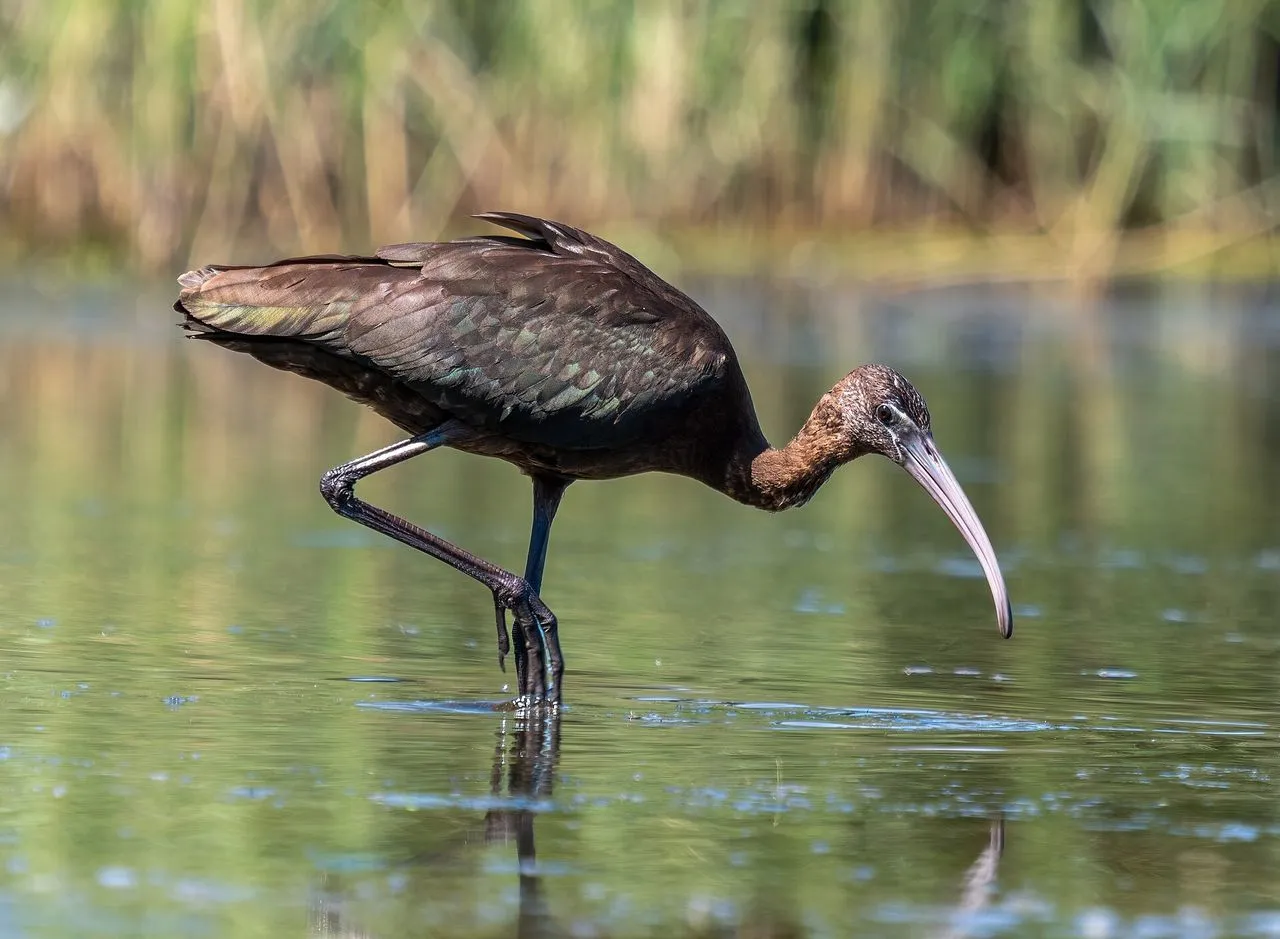
Plegadis falcinellus (Linnaeus, 1766), the Glossy Ibis, is the most widespread ibis in the world, occurring across parts of the Americas, Europe, Africa, Asia, and Australia while remaining locally tied to shallow wetlands.
Part of the Complete Waders & Herons Guide.
Identification at a glance
| Character | Glossy Ibis (Plegadis falcinellus) | White Ibis (Eudocimus albus) |
|---|---|---|
| Length | 48–66 cm (19–26 in) | 56–71 cm (22–28 in) |
| Adult body | Dark chestnut with green-bronze gloss | White with black wingtips |
| Bill | Long, downcurved, dark | Long, downcurved, red-orange |
| Juvenile | Darker, browner, fine head streaking | Brown above, white below |
| Feeding | Tactile probing in soft mud | Tactile probing in mud, turf, or shallows |
Identification
Visual
At 48–66 cm, the Glossy Ibis is a dark, slender ibis with a long downcurved bill, long legs, and extended-neck flight. Breeding adults are rich chestnut on the head, neck, and body, with glossy green, bronze, and violet iridescence on the wings and back. The facial skin is dark with pale blue or whitish lines bordering the face in breeding condition. Legs are dark reddish-brown to greyish.
Non-breeding adults and juveniles are duller, darker, and browner, with reduced iridescence. Juveniles show fine pale streaking on the head and neck. At distance, many birds look uniformly blackish until sunlight catches the wing coverts.
The main North American confusion is White-faced Ibis (Plegadis chihi) in the western interior. Breeding White-faced Ibis shows a pinkish-red facial skin patch bordered by white feathers around the eye; Glossy Ibis has bluish facial lines and lacks the full white feather border. Non-breeding birds can be difficult, and some are best left unidentified without photographs or close views.
Audio
Glossy Ibises are not strongly vocal in ordinary foraging. At colonies they give low grunts and croaks. Flight calls are generally quiet and infrequent. The feeding flock is often detected visually by its dark, long-billed silhouettes rather than by sound.
Distribution
The species has a fragmented but very broad global distribution. In North America it breeds mainly along the Atlantic Coastal Plain from the Carolinas north locally to the Northeast, in Florida, and in parts of the Gulf Coast. It also occurs in the Caribbean and through parts of Central and South America.
North American status changed substantially during the 20th century. Glossy Ibises expanded northward along the Atlantic Coast, with breeding established in the northeastern United States by the mid-1900s. The expansion likely reflects a combination of natural dispersal, availability of managed impoundments, and protection of coastal colonies. Western records require care because of White-faced Ibis overlap and hybridisation concerns.
Habitat
Glossy Ibises use shallow freshwater and brackish wetlands with soft substrates: marshes, wet meadows, rice fields, impoundments, sewage lagoons, pond margins, and flooded pastures. They avoid deep open water except in transit. Good habitat is defined less by water type than by probeable mud and dense invertebrate prey.
They often feed in flocks, sometimes mixed with White Ibis, egrets, yellowlegs, and ducks. Roosting and nesting sites are usually in marsh vegetation, shrubs, or low trees over water.
Diet and Foraging
The decurved bill is a tactile probe. Glossy Ibises feed by inserting the bill into mud or shallow water and partly opening and closing the mandibles while walking. Prey is detected by touch, not primarily by sight. Earthworms, aquatic insect larvae, beetles, snails, crayfish, small crabs, leeches, and small fish are taken.
The foraging motion is steady and repetitive: step, probe, sweep, withdraw, swallow. In soft mud the bill may disappear almost to the base. In shallow water the bird sweeps laterally through submerged vegetation. This contrasts with herons, which locate prey visually and strike with the bill closed.
Flocks can work a wet meadow systematically, each bird covering a narrow strip. The birds may feed close together when prey is dense, but aggressive spacing occurs when profitable patches are small.
Breeding Biology
Glossy Ibises nest colonially, frequently with herons, egrets, spoonbills, and other ibises. Nest sites are in reeds, cattails, shrubs, mangroves, or low trees, often above standing water. The nest is a platform of reeds, sticks, or marsh vegetation.
Clutch size is usually three to four eggs, bluish-green and sometimes marked. Incubation lasts about 20–23 days. Both sexes incubate and feed young by regurgitation. Chicks have dark down and remain in or near the nest before joining crèche-like groups in the colony vegetation.
Breeding success is highly water-dependent. If marshes dry, mammalian predators gain access and prey availability declines. If water rises rapidly, low nests may flood. Managed impoundments can support colonies when water levels are stable through incubation and chick rearing.
Notes
Glossy Ibis identification improves when observers stop expecting gloss to be visible. On overcast days the bird may appear almost black-brown. The structural marks remain: ibis shape, decurved bill, long legs, neck extended in flight.
The species' cosmopolitan distribution does not mean it is ecologically generalist at the local scale. It is broad in geography but narrow in feeding requirement: shallow water, soft substrate, and abundant invertebrates. Drain or harden the wet meadow and the bird disappears.
In eastern North America, Glossy Ibis is also a useful reminder that range maps lag living birds. A colony established on a protected coastal impoundment can produce years of local abundance, while nearby drained marshes remain empty. The bird disperses readily, but it settles only where water management leaves probeable substrate during the breeding season.
Observers should document suspected hybrids or out-of-range Plegadis carefully. Photographs of the face, eye colour, leg colour, and bare skin pattern are more valuable than general descriptions of darkness or gloss, which change dramatically with light angle.
See Also
Frequently Asked Questions
How do I tell a Glossy Ibis from a White-faced Ibis?
Breeding White-faced Ibis shows pinkish-red facial skin bordered by white feathers fully encircling the eye, while Glossy Ibis has bluish facial lines and lacks the white feather border. Leg colour also differs. Non-breeding birds can be difficult; some are best left unidentified without photographs or close views.
How does a Glossy Ibis feed?
The decurved bill functions as a tactile probe. Glossy Ibises walk steadily through shallow water or soft mud, inserting the bill and partly opening and closing the mandibles. Prey is detected by touch, not sight. Earthworms, aquatic insect larvae, beetles, snails, crayfish, small crabs, leeches, and small fish are taken.
What habitat does the Glossy Ibis require?
Shallow freshwater and brackish wetlands with soft probeable substrates: marshes, wet meadows, rice fields, impoundments, sewage lagoons, pond margins, and flooded pastures. It is broad in geography but narrow in feeding requirement, needing soft mud and dense invertebrate prey rather than any particular water chemistry.
Where do Glossy Ibises breed in North America?
Mainly along the Atlantic Coastal Plain from the Carolinas north locally to the Northeast, in Florida, and parts of the Gulf Coast. They expanded northward through the 20th century, likely through natural dispersal aided by managed coastal impoundments and protection of colonies. Western records require care because of overlap and hybridisation with White-faced Ibis.
Sources & References
- Cornell Lab of Ornithology. (2024). All About Birds: Glossy Ibis. birds.cornell.edu
- Sibley, D.A. (2014). The Sibley Guide to Birds (2nd ed.). Knopf.
- Davis, W.E. & Kricher, J. (2000). Glossy Ibis (Plegadis falcinellus). Birds of North America Online, Cornell Lab of Ornithology.
- Ehrlich, P.R., Dobkin, D.S. & Wheye, D. (1988). The Birders Handbook. Simon & Schuster.