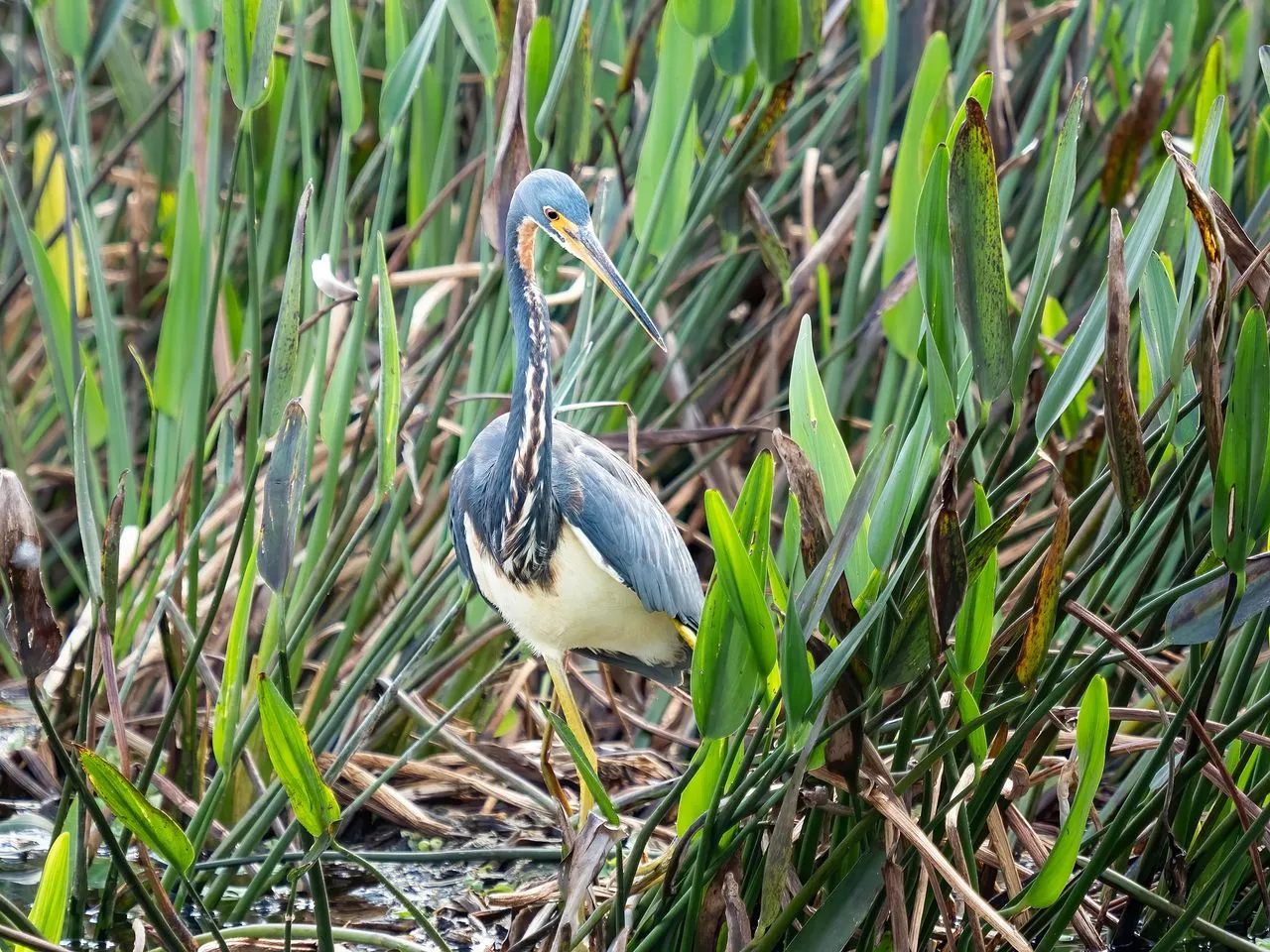
Egretta tricolor (Statius Müller, 1776), the Tricolored Heron, is the North American coastal heron most likely to be seen running, pivoting, and changing direction through shallow water while retaining a sharply defined white belly.
Part of the Complete Waders & Herons Guide.
Identification at a glance
| Character | Tricolored Heron (Egretta tricolor) | Little Blue Heron (Egretta caerulea) | Snowy Egret (Egretta thula) |
|---|---|---|---|
| Length | 56–66 cm (22–26 in) | 56–61 cm (22–24 in) | 56–66 cm (22–26 in) |
| Adult body | Blue-grey above; white belly | Slate-blue with purplish head | Entirely white |
| Juvenile | Rufous-brown neck; white belly | White, then calico | White |
| Bill | Dark tip, yellowish base | Grey-blue base, dark tip | Uniformly black |
| Foraging | Active-stalking, running, pivoting | Deliberate slow-stalking | Foot-stirring and dashing |
Identification
Visual
At 56–66 cm, E. tricolor overlaps Snowy Egret and Little Blue Heron in length but is slimmer, longer-necked, and more attenuated. Adults show blue-grey upperparts, a blue-grey to lavender neck, and a clean white belly extending from the lower breast through the vent. That white underside is the decisive field mark: Little Blue Heron is dark below as an adult, and Snowy Egret is entirely white.
The bill is long, straight, and dark-tipped, with a yellowish or horn-coloured base outside the breeding season. In breeding condition the bill base and lores may become bright blue, the legs pinkish to reddish, and filamentous plumes develop on the head, neck, and back. Legs are generally dark, and the feet often show yellowish soles or toes, but foot colour is less conspicuous than in Snowy Egret.
Juveniles are warmer brown on the neck and upperparts, with rufous tones on the head and neck and a white belly retained. They can look surprisingly unlike adults, but the combination of slim structure, dark upperparts, and white underbody remains useful.
Audio
The usual calls are harsh croaks and nasal squawks, mostly at colonies or when flushed. In flight a disturbed bird may give a rough raaah. The species is not normally located by sound in open foraging habitat; its movement pattern is more conspicuous than its voice.
Distribution
The Tricolored Heron breeds along the Atlantic and Gulf coasts of the United States, locally north to the Mid-Atlantic, through the Caribbean and Mexico, and south through Central America to northern South America and coastal Brazil. It is primarily a coastal and lowland species. Northern breeders withdraw southward after breeding; Florida, the Gulf Coast, the Caribbean, and tropical American wetlands hold birds year-round.
The North American centre of abundance is coastal, especially Florida, Louisiana, Texas, and the Carolinas. Regional declines have been reported in some colony surveys, reflecting wetland loss, altered freshwater flow, and vulnerability of low coastal nesting sites to storms and sea-level change. The global range remains broad, but local colony counts matter more than the map suggests.
Habitat
Preferred habitat is shallow coastal wetland: tidal creeks, saltmarsh pools, mangrove lagoons, brackish impoundments, oyster bars, and mudflat edges. Inland records occur, especially in post-breeding dispersal, but the species is much less characteristic of upland ponds than Green Heron or Great Blue Heron.
Water depth is typically ankle to lower-tarsus depth. The bird works margins where small fish are trapped by falling tide or concentrated in evaporating pools. It often forages near Snowy Egrets, White Ibis, and Little Blue Herons, but tends to keep its own moving track rather than joining dense ibis probing flocks.
Diet and Foraging
Small fish dominate the diet, supplemented by shrimp, small crabs, aquatic insects, tadpoles, and other shallow-water prey. The foraging style is active-stalking. A Tricolored Heron walks quickly, pauses, leans, darts, pivots, and sometimes uses partly spread wings to shade water or startle prey. It may run several steps after fish in a shallow pool, then stop abruptly and strike.
This active style separates it from the more deliberate Little Blue Heron. It also differs from Snowy Egret foot-stirring: Tricolored Herons may use foot movements and wing positions, but the dominant impression is directed pursuit rather than substrate agitation. The neck is carried extended more often during active search, then compressed for the strike.
Feeding success is tightly linked to tides. Falling tide concentrates fish along creek mouths and pool margins; high water disperses prey into marsh grass and mangrove roots. A bird that appears restless is often tracking moving prey rather than wasting energy.
Breeding Biology
Tricolored Herons nest in mixed colonies with other herons, egrets, ibises, spoonbills, and cormorants. Nest sites are usually in mangroves, shrubs, or low trees over water, often on predator-resistant islands. Nest height varies from less than a metre in marsh shrubs to several metres in mangroves.
The nest is a loose stick platform. Clutch size is usually three to four pale blue-green eggs. Both sexes incubate for about 21–25 days and feed young by regurgitation. Chicks become mobile in the nest vegetation before full flight, a typical ardeid pattern. Fledging occurs at roughly five weeks, though colony disturbance can cause premature movement and mortality.
Courtship includes stretch displays, plume erection, twig presentation, and aerial movement around the colony. Breeding plumage is brief but striking; the blue facial skin and reddish legs may be present for only a narrow window around pair formation and early nesting.
Notes
The field name "tricolored" is not decorative. In practice it means blue-grey upperparts, purplish or rufous-washed neck tones depending on age and season, and white underparts. The white belly is visible when the bird banks in flight, when it leans over water, and often when it stands side-on.
For observers building skill with the group, this is the species that teaches behaviour as identification. A medium-sized dark heron moving rapidly through a saltmarsh pool, repeatedly changing angle and showing a white underside, is not a Little Blue Heron behaving oddly; it is almost always a Tricolored Heron.
See Also
Frequently Asked Questions
How do I identify a Tricolored Heron?
Look for a slim, long-necked dark heron with a clean white belly visible when it banks in flight or leans over water. Upperparts are blue-grey, the neck is washed lavender to rufous depending on age, and the bill is long with a dark tip and yellowish base. The white belly separates it from adult Little Blue Heron and all-white Snowy Egret.
How does a Tricolored Heron forage differently from a Little Blue Heron?
Tricolored Heron uses active-stalking: walking quickly, pausing, leaning, darting, pivoting, and sometimes using partly spread wings to shade water or startle prey. Little Blue Heron is more deliberate and slower-paced. A medium dark heron moving rapidly through saltmarsh pools with a white underside is almost always a Tricolored.
Where does the Tricolored Heron live?
Shallow coastal wetlands: tidal creeks, saltmarsh pools, mangrove lagoons, brackish impoundments, oyster bars, and mudflat edges along the Atlantic and Gulf coasts of the United States, through the Caribbean and Central America to coastal South America. Inland records occur in post-breeding dispersal but it is less typical of upland ponds.
How do tides affect Tricolored Heron feeding?
Tightly. Falling tide concentrates fish along creek mouths and pool margins; high water disperses prey into marsh grass and mangrove roots. A bird that appears restless is usually tracking moving prey rather than wasting energy. Tidal pool feeding accounts for much of the species' productivity in coastal habitats.
Sources & References
- Cornell Lab of Ornithology. (2024). All About Birds: Tricolored Heron. birds.cornell.edu
- Sibley, D.A. (2014). The Sibley Guide to Birds (2nd ed.). Knopf.
- Frederick, P.C. (1997). Tricolored Heron (Egretta tricolor). Birds of North America Online, Cornell Lab of Ornithology.
- Kushlan, J.A. & Hancock, J.A. (2005). The Herons. Oxford University Press.