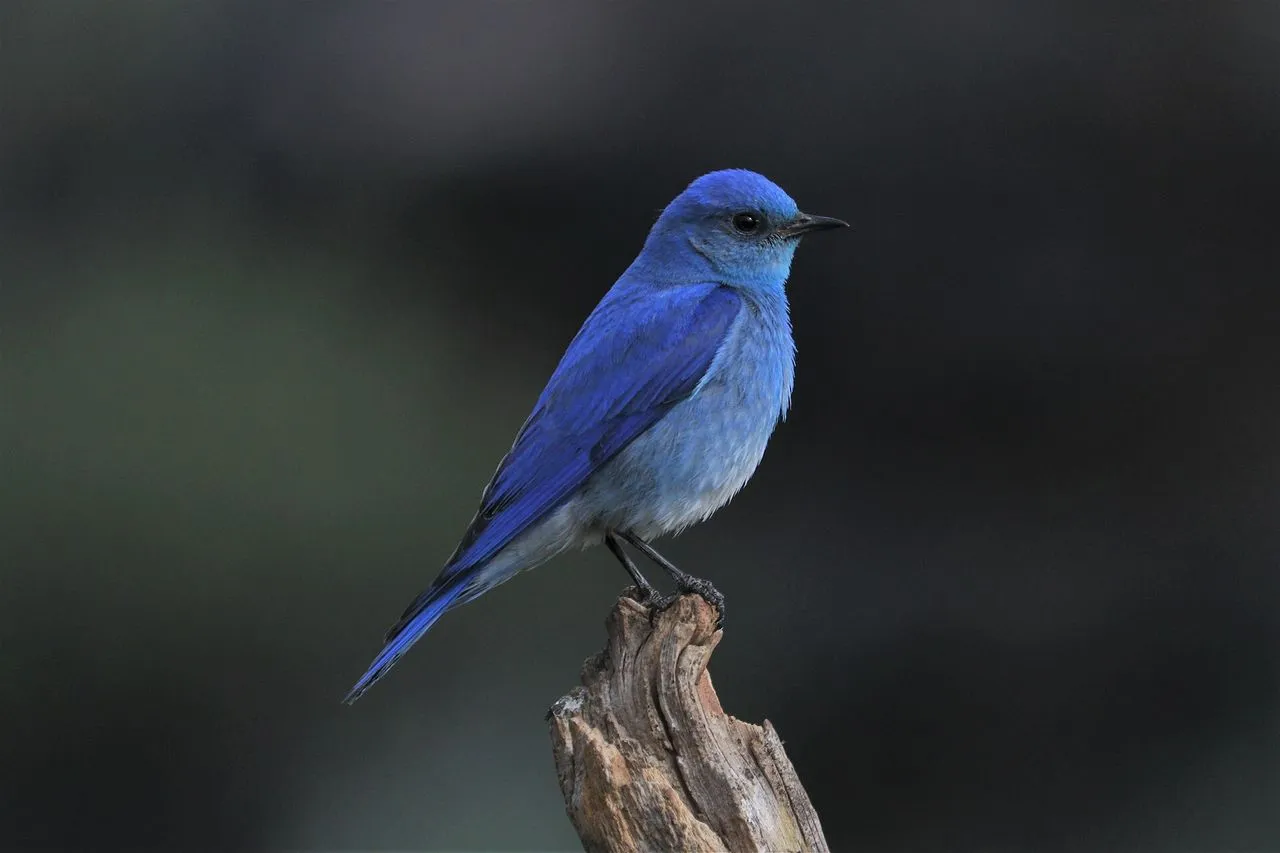
Mountain Bluebird (Sialia currucoides) is the bluest North American bluebird (16-20cm). Males are sky-blue nearly all over; females grey-brown with blue wings/tail. Most open-country bluebird, hovers while foraging.
Sialia currucoides (Bechstein, 1798), the Mountain Bluebird, is the most open-country member of its genus and the only North American bluebird in which the adult male can appear almost entirely blue.
Part of the Complete Thrushes Guide.
Identification at a glance
| Character | Mountain Bluebird (S. currucoides) | Western Bluebird (S. mexicana) | Eastern Bluebird (S. sialis) |
|---|---|---|---|
| Length | 16–20 cm (6.3–7.9 in) | 16–19 cm (6.3–7.5 in) | 16–21 cm (6.3–8.3 in) |
| Male | Pale sky-blue, no orange | Deep blue with chestnut breast and scapulars | Blue above, rusty chest, white belly |
| Female | Cold grey-brown, blue wings and tail | Warmer grey-brown, orange-brown breast | Blue-grey above, pale orange chest |
| Habitat | Treeless open country | Open oak and pine woodland | Eastern open fields and pastures |
| Foraging | Perch-drop and hovering | Perch-drop from trees or posts | Perch-drop in open ground |
Identification
Visual
Adult male Mountain Bluebird is pale sky-blue above and below, brightest on wings and tail, paler on breast and belly, with no chestnut breast band. In strong sun the bird can look almost luminous; in shade it becomes powder-blue to gray-blue. Total length is 16–20 cm, with weight usually 26–32 g. The body is slender, the bill fine, and the posture upright when perched on a fence wire or sage stem.
Adult female is gray-brown overall with blue strongest in the wings and tail. The breast is dull gray-buff, sometimes with a faint warm wash but never the strong chestnut of Western or Eastern Bluebird. This absence of orange is the key mark. Juveniles are spotted below in the Turdidae pattern, with blue restricted to wing and tail feathers.
At distance, a perched male in open grassland is usually straightforward. Females require more care. A female Western Bluebird has a warmer brown back and more orange on the breast and flanks; female Mountain is colder, grayer, longer-winged, and more tied to treeless expanses. Flight is buoyant, with frequent drops to the ground and occasional hovering.
Audio
The voice is soft and easily lost in wind. Song is a low, warbling series of short phrases, less rich than Eastern Bluebird and less emphatic than many open-country sparrows sharing the habitat. Calls include a gentle few or chur, often given in flight or from wires. Visual detection is usually more reliable than audio detection outside the immediate breeding territory.
Males sing from exposed posts, nest boxes, utility wires, and isolated shrubs. In early spring on the northern plains, song may begin while snow patches remain, especially around established box trails where returning males compete for cavities.
Distribution
Breeding range covers western North America from Alaska and western Canada south through the Rocky Mountains, Great Basin, Sierra Nevada, and high plateaus to northern Mexico. It breeds from low plains in the northern part of the range to alpine meadows and high sagebrush basins above 3,000 m farther south.
Winter range shifts south and downslope, including the Great Basin, Southwest, southern plains, northern Mexico, and open valleys of the Pacific states. Movements are flexible rather than strictly latitudinal. Severe snow cover can move birds hundreds of kilometres, while mild winters leave flocks near breeding areas where exposed ground remains.
Habitat
Mountain Bluebird requires open country with short vegetation and available cavities. Sagebrush steppe, grazed pasture, prairie, alpine meadow, burned forest openings, pinyon-juniper edges, and agricultural valleys all qualify if perches and nest sites are present. Dense woodland is avoided. Compared with Western Bluebird, Mountain Bluebird tolerates fewer trees and more expansive open ground.
The species has benefited from nest box trails in open rangeland where natural cavities are scarce. Good placement means a box facing open foraging ground, not a box buried in trees. Fence lines through pasture, lightly grazed grassland, and broad road verges can hold high densities when boxes are spaced appropriately.
Diet and Foraging
In breeding season the diet is mainly insects: grasshoppers, beetles, caterpillars, crickets, ants, flies, and spiders. Mountain Bluebird hunts from low perches but also hovers, a behaviour more developed than in Eastern or Western Bluebird. A bird may hold itself 1–5 m above grass for several seconds, then drop almost vertically on prey. This allows hunting where perches are sparse.
In autumn and winter, fruit supplements insects. Juniper berries, mistletoe berries, sumac, hackberry, and other small fruits are taken, especially during snow cover. Flocks may wander through open valleys, feeding on exposed berries and ground arthropods on warm slopes. At feeders, mealworms may be used near nest boxes, but habitat structure is the decisive factor.
Breeding Biology
Mountain Bluebird is an obligate secondary cavity nester. It uses old woodpecker holes, natural cavities in dead trees, crevices in posts, and nest boxes. It cannot excavate its own cavity. Nest boxes similar to those used by Eastern Bluebird are accepted, with a 38 mm entrance, adequate drainage, and placement on a post or pole in open country.
The nest is a loose cup of dry grasses, fine stems, and sometimes hair or feathers. Clutch size is usually 4–6 pale blue eggs, occasionally white. Incubation lasts about 13–14 days and is performed by the female. Nestlings fledge at 18–21 days, later than open-cup thrushes because cavity young remain protected while wing development proceeds.
Two broods are possible in lower-elevation or southern sites. At high elevation, late snowmelt and short insect seasons usually permit only one. Competition with Tree Swallows, House Wrens, European Starlings, and House Sparrows varies by region; House Sparrow control is essential around farms and settlements.
Notes
Mountain Bluebird is a useful indicator of open-country management because it responds to a combination of short vegetation, insect abundance, and cavity supply. Heavy grazing can create short sward but remove insect biomass; ungrazed rank grass can hold insects but make prey unavailable. The best territories often occur where grazing or fire keeps sight lines open without stripping the ground of arthropods. A bluebird box in such a place is not a decoration. It is the missing cavity in an otherwise complete breeding system.
See Also
- Eastern Bluebird (Sialia sialis)
- Western Bluebird (Sialia mexicana)
- American Robin (Turdus migratorius)
- The Complete Attracting Guide
- The Complete Thrushes Guide
- Eastern vs Western Bluebird: the close-relative pair; Mountain Bluebird differs from both by lacking rusty colour entirely.
Frequently Asked Questions
How do I identify Mountain Bluebird?
Male: pale sky-blue above and below, brightest on wings/tail, no orange anywhere. Female: grey-brown overall, blue in wings/tail, no orange breast band. Palest bluebird.
How is Mountain Bluebird different from other bluebirds?
Male lacks chestnut entirely, only bluebird without orange. Female lacks warm brown back and orange of Western. Most tied to open, treeless country, grassland, sagebrush.
Do Mountain Bluebirds use nest boxes?
Yes, use nest boxes with 38mm entrance holes, mounted on poles in open habitat. Often hover at nest sites before entering. Boxes must have predator baffles.
What do Mountain Bluebirds eat?
Primarily insects: grasshoppers, beetles, caterpillars, flies. Also some berries. Rarely at seed feeders. Attract with appropriate nest boxes in open habitat.