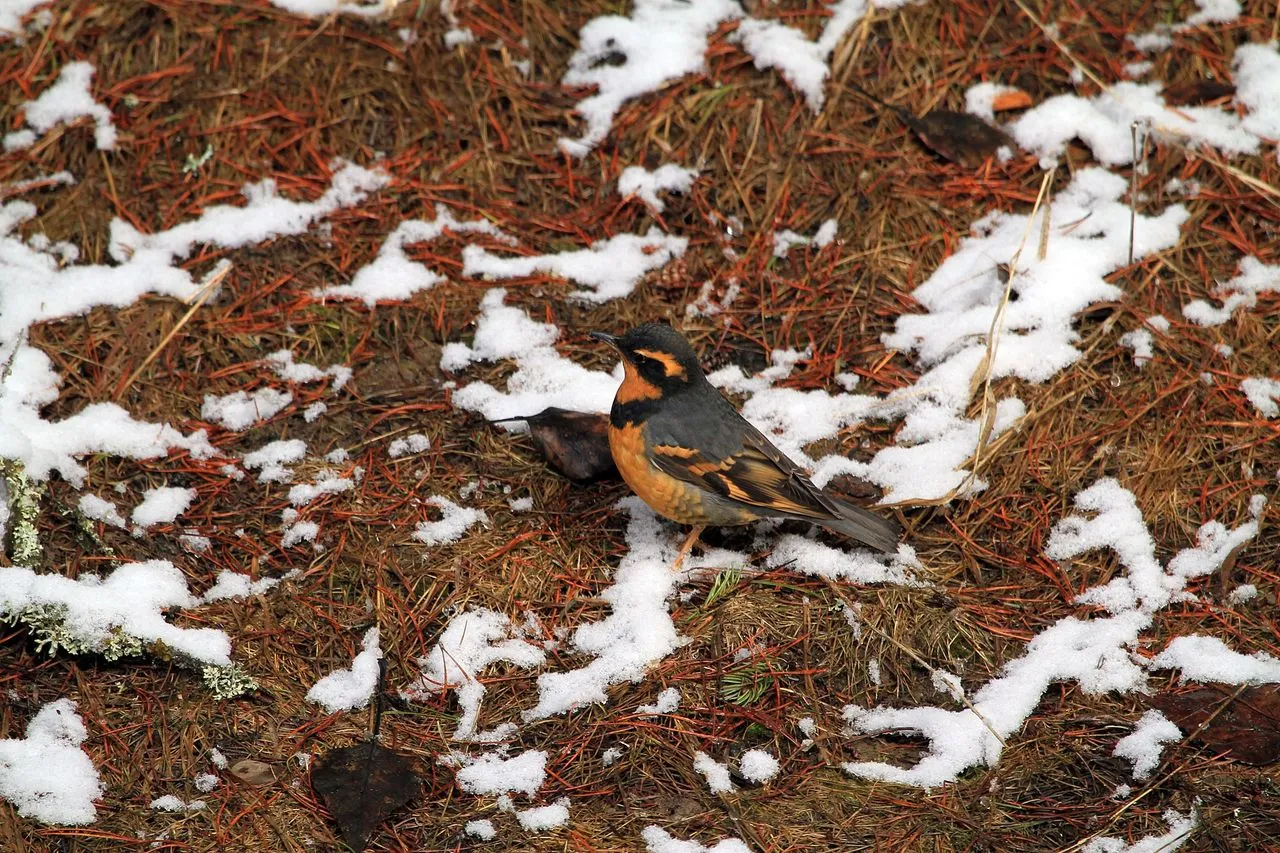
Varied Thrush (Ixoreus naevius) is a robin-sized thrush (20-26cm) of Pacific forests. Males have orange eyebrow, orange breast, black breast band. Winters in gardens when snow pushes birds to lower elevations.
Ixoreus naevius (Gmelin, 1789), the Varied Thrush, is a Pacific forest thrush that enters gardens most conspicuously in winter, when snow and poor cone or berry crops push birds to lower elevations and coastal towns.
Part of the Complete Thrushes Guide.
Identification at a glance
| Character | Varied Thrush (I. naevius) | American Robin (T. migratorius) | Hermit Thrush (C. guttatus) |
|---|---|---|---|
| Length | 20–26 cm (7.9–10.2 in) | 23–28 cm (9.1–11 in) | 15–18 cm (5.9–7.1 in) |
| Pattern | Orange eyebrow, black breast band | Orange-red breast, no breast band | Brown, spotted, rufous tail |
| Structure | Robin-sized but more horizontal | Upright, long-legged lawn thrush | Smaller spotted forest-edge thrush |
| Voice | Long single ringing whistles | Rolling carolling phrases | Flute-like phrases with pauses |
| Winter behaviour | Secretive near conifer cover | Open lawns and fruiting trees | Edges, thickets, berry cover |
Identification
Visual
The Varied Thrush is robin-sized, 20–26 cm long and about 65–100 g, but more secretive and more strongly patterned. Adult males are slate-blue to blackish above with a vivid orange eyebrow, orange throat and underparts, a broad black breast band, and orange wing bars. The face pattern is unlike American Robin: the orange supercilium cuts sharply over a dark face, and the black chest band crosses the breast like a strap.
Females are duller, olive-brown to gray-brown above, with a reduced breast band and softer orange underparts, but the same basic pattern remains visible. Juveniles are scaly and muted, yet still show warm wing markings and a hint of the breast band. In all plumages the bird looks more horizontally compressed than an American Robin, with a shorter, more cautious ground posture.
The most frequent mistake is calling a winter Varied Thrush a strange robin. The correction is structural and behavioural as much as colour-based. Varied Thrush feeds close to cover, pauses longer, and disappears into shrubs or conifers when disturbed. American Robin is usually more upright, more open-ground oriented, and lacks the breast band and orange eyebrow.
Audio
The song is not robin-like. It consists of long, thin, ringing whistles, usually one note at a time, each held for one to three seconds and separated by long pauses. The pitch changes between phrases, giving the impression of a distant referee's whistle being tested in a wet conifer forest. It carries well but can be difficult to locate because the singer remains concealed.
Calls include a sharp chuck and a thinner seep. In winter gardens, calls and wing rustle in leaf litter are often more likely than full song. Singing begins on breeding territories in spring and is most associated with mature coniferous forest.
Distribution
The breeding range follows the Pacific slope from Alaska through British Columbia, Washington, Oregon, and into northern California, with inland populations in the northern Rockies. Elevational movement is important. Birds breeding in montane conifer forest often descend in winter, while coastal populations may be resident or only locally mobile.
Winter range extends south along the Pacific Coast into California and irregularly inland across the western states. Vagrants appear almost annually far to the east, including the Great Plains, Great Lakes, and Atlantic Coast. These eastern records are usually single winter birds at fruiting trees or feeders, often during broader irruptive movement.
Habitat
Breeding habitat is moist coniferous and mixed forest, especially mature Douglas-fir, western hemlock, Sitka spruce, red cedar, and spruce-hemlock stands with mossy ground and shaded ravines. The species is strongly associated with dense canopy and cool, humid conditions. It is much less a bird of open suburban lawns than the American Robin.
In winter it uses forest edges, parks, gardens, orchards, riparian thickets, and wooded suburbs. Snow cover often brings birds to roadsides and garden feeding areas where leaf litter remains exposed under shrubs. The presence of large conifers nearby greatly increases the chance of regular winter occurrence.
Diet and Foraging
In breeding season, Varied Thrush feeds heavily on ground invertebrates: beetles, ants, caterpillars, millipedes, spiders, earthworms, and snails. It forages by scraping and flipping leaf litter, often with a sideways bill movement. In damp forest it may work mossy logs, root plates, and stream margins.
Fruit and seeds become more important in autumn and winter. It takes berries of elderberry, salal, huckleberry, Oregon grape, holly, hawthorn, crabapple, and other shrubs, and will use fallen apples in cold weather. At feeders it may take mealworms, suet fragments, raisins that have been soaked, or scattered hulled sunflower, but it rarely behaves like a feeder specialist. Food placed low near cover is used more readily than exposed platform stations.
Breeding Biology
The nest is a bulky cup of twigs, grasses, moss, bark strips, and mud or wet plant material, lined with fine grasses. It is placed in a conifer or dense shrub, often on a horizontal branch close to the trunk, commonly 1–5 m above ground but sometimes higher. Nest sites are shaded and difficult to see from below.
Clutch size is typically 3–4 eggs, blue-green with reddish or brown markings. Incubation lasts roughly 12–14 days, mostly by the female. Nestlings fledge after about 13–15 days. Pairs may attempt a second brood in favourable coastal conditions, but shorter montane seasons usually limit productivity.
Breeding density declines where mature conifer structure is simplified. Clearcuts may provide some edge for winter foraging after regrowth, but they do not replace the cool, closed-canopy nesting conditions used by territorial birds.
Notes
Varied Thrush irruptions are not random wanderings by lost birds. Winter numbers at low elevations rise when snow covers forest-floor feeding sites or when berry crops fail across large areas. The same pressure that brings a bird to a Seattle garden can carry another across the continent. Eastern vagrants often survive for weeks if they find crabapple, holly, or ornamental fruit, but they remain edge-haunting forest thrushes, not converted feeder birds.
See Also
Frequently Asked Questions
How do I identify Varied Thrush?
Male: slate-blue above, vivid orange eyebrow and breast, black breast band across chest. Female: duller olive-brown with reduced breast band. More patterned than American Robin.
What does Varied Thrush song sound like?
Not robin-like, long, thin, ringing whistles, one note at a time, each held 1-3 seconds. Carries through wet conifer forest but bird remains concealed.
When do Varied Thrushes appear in gardens?
Winter visitor to gardens when snow and poor cone/berry crops push birds to lower elevations and coastal towns. Secretive, stays near cover, disappears into shrubs.
How is Varied Thrush different from American Robin?
Varied has black breast band, orange eyebrow, American Robin lacks both. More horizontally compressed, more secretive, shorter, more cautious posture.