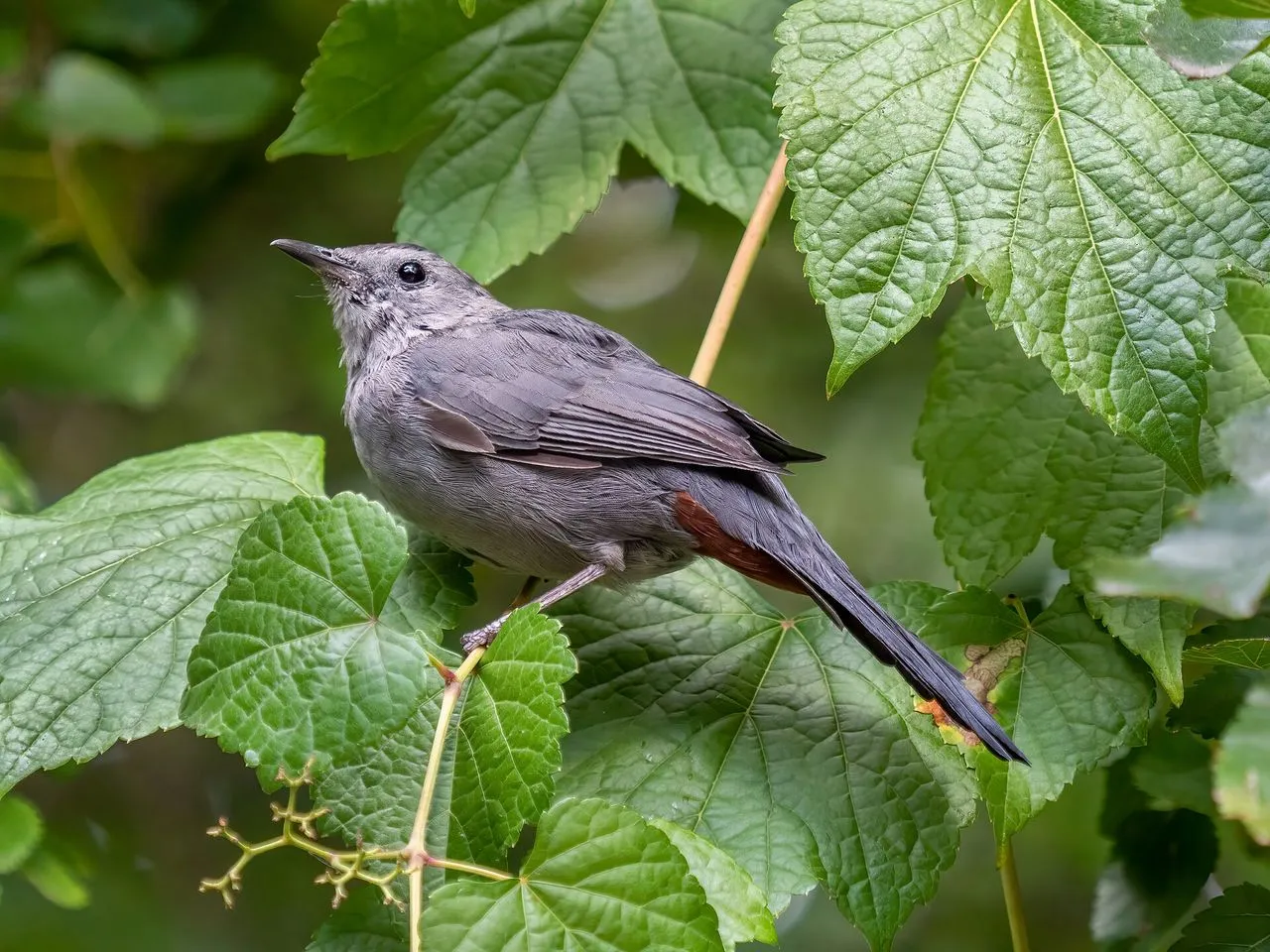
Gray Catbird (Dumetella carolinensis) is a mimid (21-24cm), not a true thrush. Slate gray with black cap, chestnut undertail. Named for cat-like mew call. Long, skulking tail-flicks. Dense thicket dweller with varied song.
Dumetella carolinensis (Linnaeus, 1766), the Gray Catbird, is a mimid rather than a thrush, but its thicket habits and fruit use make it a regular point of confusion in eastern North American garden edges.
Part of the Complete Thrushes Guide.
Identification at a glance
| Character | Gray Catbird (D. carolinensis) | Northern Mockingbird (M. polyglottos) | American Robin (T. migratorius) |
|---|---|---|---|
| Length | 21–24 cm (8.3–9.4 in) | 21–26 cm (8.3–10.2 in) | 23–28 cm (9.1–11 in) |
| Plumage | Slate grey, black cap, chestnut undertail | Grey above, pale below, white wing patches | Grey-brown above, orange-red breast |
| Behaviour | Skulks and tail-flicks in thickets | Runs openly, flashes wings | Runs and stops on lawns |
| Voice | Nasal cat-like mew | Repeated mimic phrases | Rolling carol |
| Habitat | Dense shrubs and vines | Open yards with shrubs | Lawns, parks, fruiting trees |
Identification
Visual
Gray Catbird is a medium-sized songbird, 21–24 cm long and usually 23–56 g, with uniform slate-gray plumage, a black cap, long dark tail, and a chestnut patch under the tail that is often visible only when the bird flicks or lifts the tail. The bill is slender and dark. The body is slimmer and longer-tailed than a small thrush, and the movement is more skulking and elastic.
Sexes are alike. Juveniles are duller gray-brown with a reduced black cap and softer undertail colour, but they still show the long tail and thicket behaviour. The species is unlikely to be confused with any spotted thrush in good view; confusion usually arises from brief glimpses in berry shrubs, where observers register a gray-brown bird and a thrush-like size.
Compared with Northern Mockingbird, Gray Catbird is darker, smaller, lacks white wing patches, and remains closer to dense cover. Mockingbird walks and runs in the open with conspicuous wing flashes; catbird slips through shrubs and often reveals itself by voice before shape.
Audio
The signature call is a nasal, cat-like mew, sometimes startlingly mammalian from inside a hedge. This single call is the basis of the common name and is the best confirmation when the bird remains concealed. Alarm calls include harsh chatters and scolds.
Song is a long sequence of varied phrases, including imitations, squeaks, whistles, and short musical notes. Unlike Northern Mockingbird, which commonly repeats a phrase several times before switching, Gray Catbird tends to deliver phrases once and move quickly to the next. The result is a rambling, improvisational song from dense cover, often lower and less projected than mockingbird song.
Distribution
Gray Catbird breeds across eastern and central North America, from the Canadian Prairie provinces and southern Canada through the eastern United States, and west locally into the Great Plains and Rocky Mountain foothills where thickets occur. It is largely absent as a breeder from the arid Southwest and most of the Pacific Coast.
Migration is nocturnal. Spring arrival in the southeastern United States begins in April, with northern territories occupied in May. Autumn departure occurs from August through October. Winter range includes the southeastern United States, Caribbean, Mexico, and Central America, with small numbers wintering north where fruit and cover persist.
Habitat
The species is tied to dense, low vegetation: hedgerows, shrubby wetlands, regenerating woodland, forest edges, overgrown fields, streamside tangles, suburban shrub borders, and gardens with bramble-like structure. It avoids both closed mature forest with little understorey and open lawn without cover.
A suitable garden has layered shrubs, vines, and fruiting cover. Native dogwood, elderberry, viburnum, serviceberry, blackberry, raspberry, spicebush, and grape all increase use. A clipped hedge with bare ground beneath is less useful than a mixed, irregular thicket with leaf litter and fruit.
Diet and Foraging
Insects and other arthropods dominate the breeding-season diet: beetles, ants, caterpillars, grasshoppers, flies, spiders, and small larvae. Catbirds forage by gleaning from leaves, probing fruit clusters, and dropping to the ground under shrubs. They are less open-ground oriented than robins and less perch-and-drop than bluebirds.
Fruit becomes increasingly important from midsummer onward and may dominate during migration. Elderberries, dogwoods, viburnums, cherries, blackberries, raspberries, grapes, and pokeweed are heavily used. Catbirds also visit suet, grape jelly, oranges, and mealworms, but these foods can draw them into conflict with orioles and mockingbirds. Planting fruiting shrubs is the more stable intervention.
Breeding Biology
The nest is a bulky cup of twigs, leaves, grasses, bark strips, and rootlets, lined with finer material. It is placed in dense shrubs or vine tangles, usually 0.5–2 m above ground. Sites are often difficult to inspect without damaging the vegetation, which is part of their value.
Clutch size is usually 3–4 eggs, deep greenish blue and unmarked. Incubation lasts about 12–13 days, mostly by the female. Nestlings fledge after 10–11 days and remain in dense cover while adults feed them. Two broods are common in much of the range.
Gray Catbirds are among the passerines that regularly recognise and reject Brown-headed Cowbird eggs. They often puncture or eject the cowbird egg, reducing parasitism costs. This ability is not perfect, but it is more developed than in many open-cup nesting hosts.
Notes
Catbird mimicry is real but structurally different from mockingbird mimicry. A Gray Catbird can incorporate copied notes from other birds, mechanical sounds, and local acoustic fragments, but it usually avoids the repeated triplet pattern that makes a mockingbird obvious. The bird's ecology is also different: the catbird is a hedge specialist. If a gray mimic is singing from the top of a television aerial at midnight, suspect mockingbird. If the sound comes as a muttered sequence and a nasal mew from inside dogwood and grape, suspect catbird.
See Also
Frequently Asked Questions
How do I identify Gray Catbird?
Uniform slate-gray body, black cap, long dark tail, chestnut patch under tail (visible when lifted). Slender dark bill. Slinks through shrubs rather than walking in the open.
Why is it called Catbird?
The distinctive call is a nasal, cat-like mew, often the first clue the bird is present. Call gives the species its name and confirms identity in dense cover.
What does Gray Catbird song sound like?
Long, rambling sequence of varied phrases including imitations, squeaks, whistles. Unlike mockingbird, delivers each phrase once before moving on. Sings from dense cover.
Do Gray Catbirds use feeders?
Rarely at seed feeders. Attract with fruit: berries, sliced apples, grapes. Also mealworms. Provide dense shrubby cover, they stay in vegetation, rarely come to open feeders.