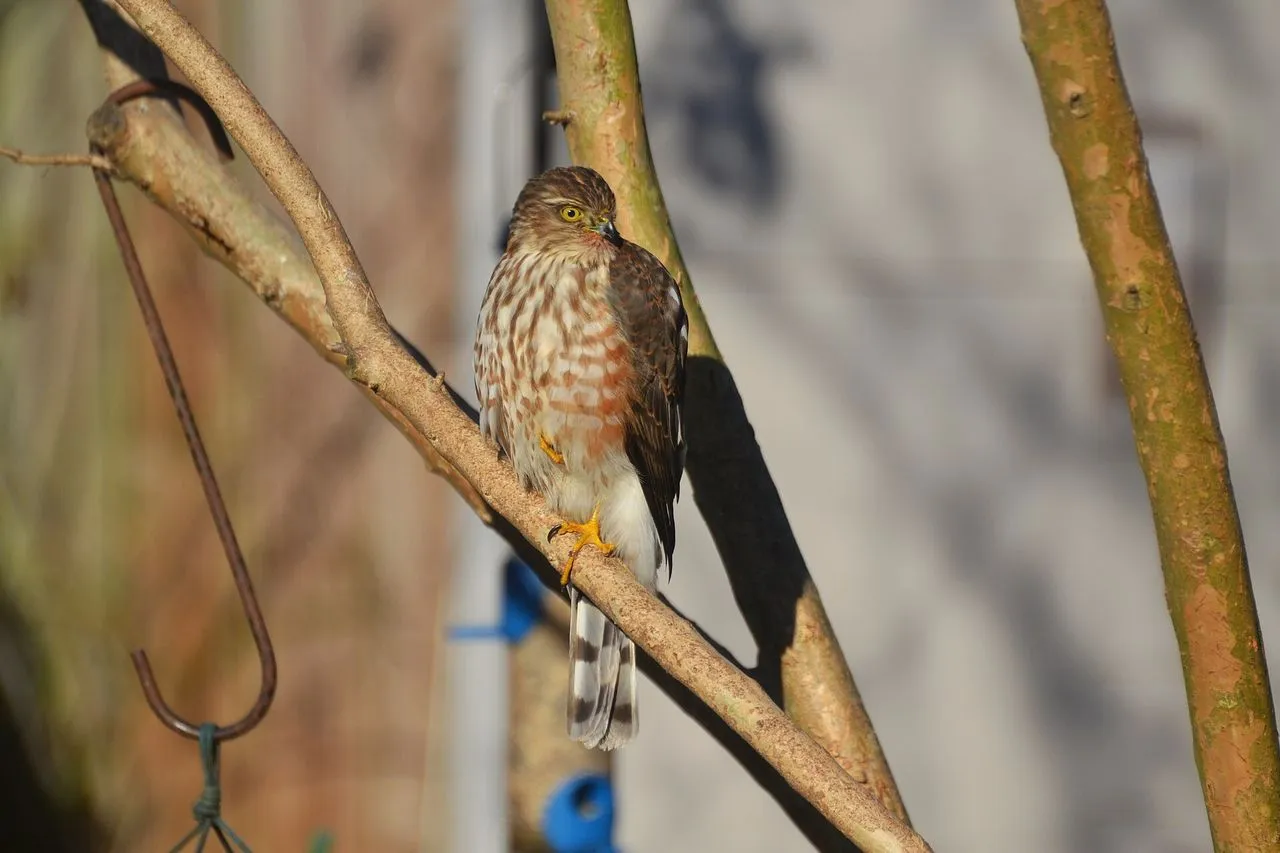
Feeder within 3m of cover (quick escape) OR more than 10m away (altitude gain). Within 1m of windows is safest, birds can't reach lethal speed. Use the 3-metre rule to avoid hawk ambush zones. Keep cats indoors. Mark windows on exterior with 5cm grid patterns.
A feeder placed 1 m from a window is usually safer than one placed 4 m from the same window. Within about 1 m, a flushed bird rarely reaches lethal speed; at 3 to 10 m, it can. That counterintuitive spacing rule prevents more deaths than most hawk deterrents.
Most predator-proofing advice confuses visible drama with mortality. A Cooper's Hawk taking a finch is conspicuous. A cat killing three birds under a shrub and a window killing two more before breakfast are often invisible.
Part of the Complete Attracting Guide.
Specifications / What Actually Works
| Risk | Safer layout | Why it works | Watch point |
|---|---|---|---|
| Window strike | Feeder within 1 m (3 ft) of glass | Birds cannot reach lethal speed | Treat glass if farther out |
| Cat ambush | Cover 2–3 m (6–10 ft) away | Escape cover without a hiding tunnel | Keep ground below feeder open |
| Hawk attack line | Shrubs or brush interrupt direct flight | Breaks the low approach | Do not remove all cover |
| Rodent predators | No ground seed overnight | Reduces rats and fox interest | Sweep every 2–3 days |
| Squirrel route | Baffled pole in open ground | Stops predator corridors to the station | Keep launch points 3 m+ away |
Start with station geometry. Place feeders either within 1 m of glass or more than 10 m away. The dangerous zone is the middle distance, where birds flush hard and strike at speed. If the feeder must sit in that zone, treat the glass.
Window treatment must be external and close-spaced. Use dots, tape, cords, or decals on the outside surface, spaced no more than 5 cm apart vertically or horizontally. One hawk silhouette in the corner does almost nothing. Birds try to fly through the unmarked gaps. External marks interrupt the reflection before the bird reaches the glass.
Cover should be near but not touching the feeder. Small birds need escape cover 2 to 3 m away. Dense shrubs directly under or beside the feeder are cat cover. The best arrangement is a feeder in open ground with thorny or dense vegetation a short flight away, not an ambush tunnel.
Cats are the primary mammalian predator problem. Keep pet cats indoors, in a catio, or on a supervised harness. Bell collars reduce some hunting success but do not make an outdoor cat safe for birds. Ultrasonic devices and scent granules are unreliable. A ground-feeding station in a neighbourhood with free-roaming cats is an avoidable trap.
Use pole-mounted feeders with baffles and open sightlines below. Trim vegetation within 1.5 m of the pole base if cats use it as cover. Avoid scattering seed on the ground; it forces birds to feed heads-down, and it attracts rodents that bring more predators.
Hawks are different. Accipiters hunt feeders because feeders concentrate prey. You cannot make small birds completely hawk-proof without also making the feeder unusable. What you can do is break the attack line. Place brush piles or shrubs 2 to 3 m away so birds have a short escape route, and avoid placing feeders beside long open corridors that allow a low, fast approach.
Do not remove all cover to stop hawks. Birds feeding in a bare lawn are more exposed, not less. The aim is interrupted flight paths and rapid refuge, not a sterile display area.
Feeder type affects risk. Platform feeders hold birds in the open longer and attract doves, sparrows, and squirrels. Tube feeders let small birds arrive, take a seed, and leave quickly. For feeder selection, see Choosing the right feeder. Water needs the same risk calculation; see Birdbaths and water features.
Common Mistakes
- Treating hawks as the main problem. In most suburban gardens, cats and glass kill more birds than raptors do.
- Putting feeders 3 to 5 m from large reflective windows. That is almost the worst possible distance.
- Using one decorative window decal. Collision prevention requires a pattern, not a symbol.
- Creating dense ground cover under feeders. It hides cats and concentrates spilled seed.
- Feeding heavily during a disease outbreak or predator concentration event. Sometimes the safest feeder is an empty feeder for a week.
Maintenance & Hygiene
Walk the feeder area every morning for two weeks after changing station layout. Look for feather piles, strike marks on glass, stunned birds, and cat tracks. Predator-proofing is not a purchase; it is an audit.
Clean spilled seed every 2 to 3 days. Hull build-up attracts rodents, and rodents attract foxes, cats, raccoons, and owls. If you cannot keep the ground clean, switch to hulled sunflower in a catch tray or reduce the amount offered.
Inspect window markings monthly. Tape peels, cords shift, and decals fall. The effective spacing standard remains 5 cm; if gaps widen, the window is again dangerous.
If a hawk begins using the feeder station daily, stop feeding for 7 to 10 days. The small birds will disperse to natural food sources, and the hawk will adjust its route. This is not anti-hawk. It is anti-concentration. A feeder should not function as a predictable prey trap.
See Also
- Dealing with Invasive Birds
- Window Strike Prevention
- The Complete Attracting Guide
- Why Is My Suet Disappearing Overnight?: the nocturnal-mammal companion to the daytime predator-proofing rules.
- Raccoons and Bird Feeders: the raccoon-specific exclusion guide with paw-print ID, welded-steel cage specs, and the Baylisascaris hygiene angle.
- Keeping Cats From Killing Feeder Birds: evidence-ranked interventions from indoor confinement to Birdsbesafe collars, with the 2.4 billion-bird mortality data.
Frequently Asked Questions
Where is the safest place for a feeder?
Within 3m of dense cover (shrubs) for quick escape OR more than 10m away (bird gains altitude before reaching potential predators). The dangerous zone is 3–10m where accipiter hawks can ambush departing birds.
How do I protect against cat predation?
Keep cats indoors or in enclosed catios. Bell collars don't work reliably. 'Birdsbesafe' bib-style collars have modest effectiveness. The most effective solution is preventing cat access to the garden entirely during daylight hours.
Does feeder placement near windows help?
Yes, within 1m of a window, a flushed bird rarely reaches lethal speed. The danger is at intermediate distances (3–10m) where impact velocity is high. Place feeders either very close to windows or far from them.
What hawk deterrents work at feeders?
Place feeders so birds have clear sightlines and time to escape. The '3-metre rule' (feeder within 3m of cover OR >10m away) is more effective than any visual deterrent. Hawks ambush from cover, clear sightlines reduce success.