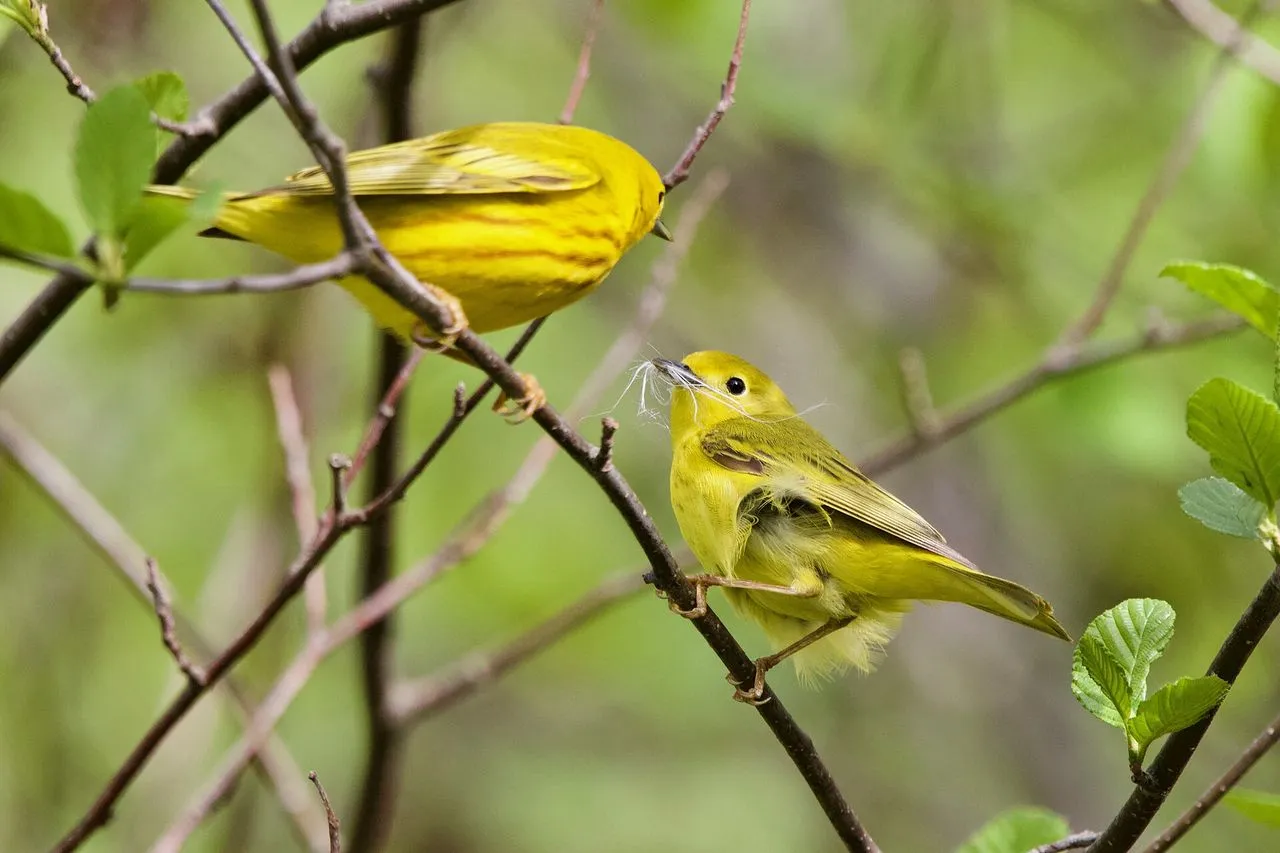
Yellow Warbler (Setophaga petechia) is North America's most widespread breeding warbler. Males have bright yellow overall with reddish breast streaks. Song is 'sweet-sweet-sweet-I'm-so-sweet'. Breeds across the continent in willows, alders, and wetland shrubs.
Setophaga petechia is the most geographically widespread breeding warbler in North America, nesting from Alaska and the Yukon south through Mexico, with year-round subspecies present on Caribbean islands and in coastal mangroves from the Gulf of Mexico to Ecuador.
Part of the Complete Warblers Guide.
Identification
The adult male is unmistakable among North American warblers: entirely yellow plumage with reddish-brown breast streaks running from the throat to the lower breast. No other widespread parulid combines an unmarked yellow head with streaked underparts. Females are duller, olive-yellow above and paler yellow below, without streaks. Both sexes show yellow spots in the tail feathers, visible as a pattern of yellow patches in the otherwise dark tail during flight.
Body length 12 to 13 cm, weight 8 to 10 g. Bill fine and slightly decurved, dark grey. Legs grey. The plain yellow face of both sexes shows no strong eye or auricular pattern, which separates it at a glance from most other small yellow birds.
Song and Calls
The advertising song is a high, rapid series conventionally rendered as sweet-sweet-sweet-I'm-so-sweet or sweet-sweet-sweet-sweeter-than-sweet, typically accelerating and rising in pitch toward the terminal phrase. Males sing persistently from exposed willow or alder perches on territory from late April through late June. Singing diminishes sharply by mid-July.
The contact call is a relatively soft "chip," slightly musical in quality compared with the harder calls of most other Setophaga species, which helps locate birds moving through dense vegetation outside the song season.
Confusion Species
| Species | Key separator |
|---|---|
| Wilson's Warbler (Cardellina pusilla) | Solid black cap on males; no breast streaks; slightly smaller overall |
| American Goldfinch (Spinus tristis) | Black wings with white wingbars; heavy seed-cracking bill; undulating flight |
| Orange-crowned Warbler (Leiothlypis celata) | Dull olive-yellow throughout; no reddish streaks; no yellow tail spots |
Distribution
Setophaga petechia breeds across the widest latitudinal range of any North American warbler, from the Yukon at around 65°N south through all 48 contiguous states, Mexico, and the Caribbean. The species divides roughly into the migratory northern populations (the aestiva group, often called "Northern Yellow Warbler") and the largely resident "Mangrove Yellow Warbler" populations of the Caribbean and tropical coasts. Up to 35 subspecies are recognised depending on the authority consulted.
Winter range for northern migrants covers Mexico, Central America, the Caribbean, and northern South America to Peru.
Habitat
Dense low woody vegetation near water is the consistent requirement across the breeding range. Willows (Salix) and alders (Alnus) along stream margins, pond edges, and wetland borders are the primary association. In suburban settings, a dense shrub layer within 50 m of standing or moving water is sufficient to attract territory-holding birds in May.
Yellow warblers tolerate early successional and disturbed habitats well. Beaver ponds, roadside willow scrub, and restored wetland margins all hold breeding pairs. In the west, montane riparian corridors with alder and willow serve as the main breeding habitat up to around 3,000 m. Unlike many parulids that require mature forest structure, this species does well wherever dense low woody cover exists near water.
Diet
Caterpillars form the largest fraction of the breeding-season diet, with geometrid and sphingid larvae dominating. Beetles, aphids, midges, and damselflies contribute the remainder. The fine bill is adapted for gleaning from leaf surfaces and from within rolled or folded leaves. Yellow warblers have been observed following cattle and deer to catch insects flushed by large mammals moving through vegetation.
Small amounts of berry flesh, particularly elderberry (Sambucus), appear in the diet during late summer before migration.
Breeding Biology
Females build the nest alone: a compact cup of plant fibres, grasses, and spider silk placed in the vertical fork of a shrub or low tree branch at 0.5 to 3 m above ground. Nests sit within dense vegetation rather than in exposed positions.
Clutch size is typically 4 to 5 eggs, pale greenish-white with brown blotches concentrated at the larger end. Incubation runs 11 to 12 days, carried out almost entirely by the female. Both parents provision chicks, which fledge at 9 to 12 days. Double-brooding is common where the season allows.
Brown-headed Cowbird (Molothrus ater) parasitism is frequent throughout the range. Yellow Warblers respond in a distinctive way: rather than ejecting the parasitic egg, a female may bury the entire nest contents by constructing a new nest floor directly over the parasitised clutch and re-laying on top. This cycle can repeat. Nests with up to six distinct floors have been documented, each layer representing one cowbird parasitism event and one burial response. It is among the best-documented anti-parasitism behaviours in North American passerines.
Notes
Yellow Warblers are among the earliest parulids to begin autumn migration, with adults departing breeding territories from late July, well ahead of most other warblers. Spring arrivals reach the Gulf Coast from late March and push north rapidly, reaching the Canadian border by early May in most years.
A garden planting of native willows or shrub dogwood, allowed to grow into dense multi-stemmed form near standing water rather than pruned into formal shapes, provides the nesting and foraging structure a territorial pair requires.
See Also
- Common Yellowthroat: the masked wetland warbler with the wichity-wichity song.
- Hooded Warbler: another bright eastern warbler that uses dense cover and flashes white tail feathers.
- Prothonotary Warbler: the golden swamp specialist of flooded woods and wooded wetlands.
- Yellow-rumped Warbler: a broader-ranging yellow warbler for comparison with migrant versatility.
- The Complete Warblers Guide: family taxonomy, migration, and identification structure.
- Yellow Warbler vs Yellow-rumped Warbler: all-yellow vs patchy-yellow, with seasonal pattern and habitat differences.
Frequently Asked Questions
How do I identify Yellow Warbler?
Male: bright yellow overall with reddish-brown streaks on breast. Female: duller yellow with reduced streaking. The yellow is more uniform than other warblers, less contrast between head and body. Look for the reddish streaks on the breast.
What is the Yellow Warbler song?
A sweet, lively series: 'sweet-sweet-sweet-I'm-so-sweet' or 'sweet-sweet-sweet-titi'. The song is one of the most distinctive and frequently heard warbler songs across North America.
Where does Yellow Warbler breed?
From Alaska and Yukon south through Mexico. Found in willows, alders, cottonwoods, and other wet shrub habitat. One of the few warblers that also breeds in the Pacific Northwest and interior west.
Does Yellow Warbler use feeders?
Rarely, they are primarily canopy foragers in shrubs and trees. Migrants may occasionally take fruit or suet in winter, but they do not regularly visit seed feeders.