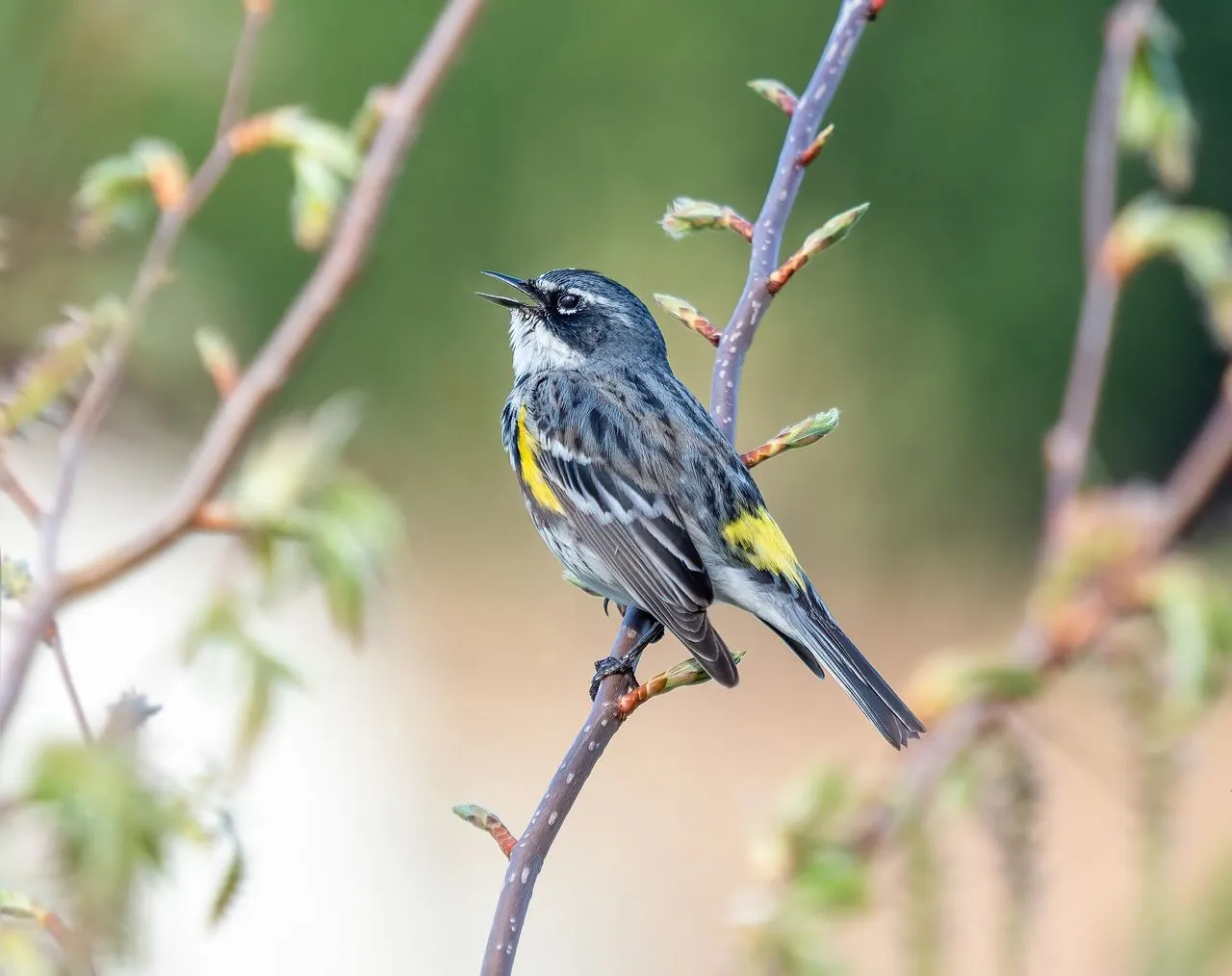
Yellow-rumped Warbler (Setophaga coronata) is the only North American warbler that winters north of Mexico in large numbers (12–15cm, 10–14g). Two subspecies: 'Myrtle' (white throat) and 'Audubon's' (yellow throat). Eats berries in winter, insects in summer.
Setophaga coronata Linnaeus, 1766, the Yellow-rumped Warbler, is a 12 to 15 cm parulid weighing 10 to 14 g and the only North American wood-warbler that routinely winters north of Mexico in large numbers.
Part of the Complete Warblers Guide.
Identification at a glance
| Form or feature | Key separator |
|---|---|
| Myrtle Warbler (Setophaga coronata coronata group) | White throat, dark auricular patch, stronger black-and-white face in breeding males |
| Audubon's Warbler (Setophaga coronata auduboni group) | Yellow throat, greyer face, more extensive yellow on the face |
| Intergrades | Mixed throat and face pattern in the Rocky Mountain hybrid zone |
| Shared mark | Yellow rump visible in all plumages, even dull winter birds |
| Size context | 12 to 15 cm (4.7 to 5.9 in), 10 to 14 g (0.4 to 0.5 oz) |
Identification
Visual
The diagnostic field mark is the yellow rump patch, visible even when the bird is otherwise grey-brown and anonymous in winter. Breeding males show a yellow crown patch, yellow flank patches, white wing bars, streaked breast sides, and a dark face pattern that differs by subspecies. Females and autumn birds are duller but retain the yellow rump, narrow wing bars, and streaked flanks. Body shape is stockier than many Setophaga, with a relatively long tail and a habit of perching more openly than canopy specialists.
The eastern "Myrtle" group has a white throat in all plumages, a dark auricular patch, and stronger black-and-white facial contrast in breeding males. The western "Audubon's" group has a yellow throat, a greyer face, and a less sharply bordered auricular. Intergrades occur regularly in the Canadian Rockies and adjacent interior West, where throat colour and face pattern may not resolve cleanly. The north-western "Goldman's" and Guatemalan groups are geographically restricted and darker, but most North American observers encounter Myrtle, Audubon's, or intergrades.
Audio
The song is a loose, even trill, usually 4 to 8 seconds long, weaker and less patterned than the songs of many breeding warblers. It often begins with several slightly separated notes and settles into a soft, wavering series. The common call is a hard, dry chek, frequently given from shrubs, bayberry thickets, and woodland edges during migration and winter. In mixed flocks the call is often the first clue, but the voice is not as individually distinctive as the rump patch.
Distribution
Breeding range spans the boreal forest from Alaska across Canada to Newfoundland, with additional montane breeding through the western United States, the Great Basin ranges, the Rockies, and parts of the Pacific Coast. Myrtle Warblers breed mainly across the northern and eastern boreal belt; Audubon's Warblers breed chiefly in western coniferous mountains.
Migration is broad-front and conspicuous. Spring movement begins along the Gulf Coast and southern Atlantic states in March, reaches the Great Lakes and New England during April, and continues into boreal breeding areas through May. Autumn migration starts in August, peaks across much of the eastern United States in October, and extends into November. Winter range includes the Pacific Coast, southern and eastern United States, Mexico, Central America, and the Caribbean, with many birds remaining in coastal New England and the Mid-Atlantic where waxy fruits persist.
Habitat
Breeding habitat is primarily coniferous or mixed forest. In the boreal zone the species uses spruce, fir, tamarack, and pine stands, especially where edges, bog margins, or open patches provide singing posts and foraging space. In western mountains it breeds in pine, fir, Douglas-fir, and mixed conifer forest from low foothills to subalpine elevations above 2,500 m.
Outside the breeding season it becomes one of the most habitat-flexible warblers. Birds use coastal bayberry scrub, juniper edges, orchards, gardens, golf courses, pine plantations, mangroves, and open woodland. The winter association with fruit-bearing shrubs is strong enough that a line of wax myrtle can hold dozens of birds when adjacent woodland appears quiet.
Diet and Foraging
In the breeding season Yellow-rumped Warblers take caterpillars, beetles, flies, leafhoppers, scale insects, and spiders by gleaning branches and needles, hovering briefly at foliage tips, and sallying after aerial prey. They forage from low shrubs to the upper canopy but often use exposed outer branches more than many warblers.
The species' winter success rests on digestive tolerance of wax-coated fruits. Bayberry and wax myrtle fruits contain lipids that many insectivorous passerines cannot exploit efficiently. Yellow-rumped Warblers also eat juniper berries, poison ivy fruits, dogwood berries, and small amounts of suet or peanut fragments at feeders. This dietary shift permits wintering at latitudes where flying insects are unavailable for long periods. During mild winter afternoons birds still flycatch over water, manure piles, or sunny woodland edges, but fruit carries them through cold intervals.
Breeding Biology
Pairs form soon after arrival on breeding territories. The nest is an open cup placed on a horizontal conifer branch, usually 1.5 to 15 m above ground and often concealed against the trunk or in dense needles. Females build with twigs, bark strips, rootlets, grasses, and conifer needles, lining the cup with hair and feathers.
Clutch size is usually 4 or 5 eggs, whitish to pale green with brown spotting. Incubation lasts about 12 to 13 days and is performed mainly by the female. Both adults feed nestlings, which leave the nest at roughly 10 to 12 days. Northern pairs usually raise one brood; southern and montane pairs may attempt a second when snowmelt and insect timing allow. Brown-headed Cowbird parasitism occurs but is less central to the species' breeding ecology than it is in low-shrub warblers.
Notes
The Myrtle and Audubon's forms were long treated as separate species, then merged after evidence of hybridisation in western Canada. Genomic work shows substantial differentiation despite the hybrid zone, and taxonomic treatment remains unsettled. For field purposes the practical point is simpler: throat colour separates most birds, but intergrades demand attention to the full pattern of throat, auriculars, back tone, and flank streaking rather than a single mark.
See Also
- Palm Warbler: the boreal ground-forager that shares bogs and peatland edges and shares the Yellow-rumped Warbler's winter open-country behaviour.
- Magnolia Warbler: the boreal conifer breeder that shares spruce-fir forest and similar tail pattern identification clues.
- Pine Warbler: the pine specialist for comparison of conifer-foraging parulids and seed tolerance at feeders.
- Blackburnian Warbler: the high canopy boreal specialist whose conifer zone overlaps with Yellow-rumped Warbler breeding range.
- The Complete Warblers Guide: full family reference: taxonomy, migration, and identification structure.
- Why Are Warblers in My Garden in Fall?: the most common fall and overwintering warbler in temperate North America, in context.
- Yellow Warbler vs Yellow-rumped Warbler: the canonical North American yellow-warbler ID problem with a 12-row table.
Frequently Asked Questions
What is the difference between Myrtle and Audubon's Warbler?
Myrtle (eastern): white throat, white eye stripe. Audubon's (western): yellow throat, more extensive yellow on face. They were formerly considered separate species. Hybridization occurs in the Rockies.
Why can Yellow-rumped Warbler survive winter in cold climates?
Their ability to digest berries (especially bayberry, juniper) gives them a winter food source other warblers lack. They are the most adaptable warbler, will eat insects, fruit, and sometimes seed.
Does Yellow-rumped Warbler use feeders?
Yes, more than most warblers. They'll take suet, fruit, and sometimes mealworms in winter. The 'Myrtle' form is common at winter feeders in the eastern US.
Where does Yellow-rumped Warbler breed?
Coniferous and mixed forests across Canada, the northern US, and western mountains. Uses conifers for nesting, often near forest edges or clearings.