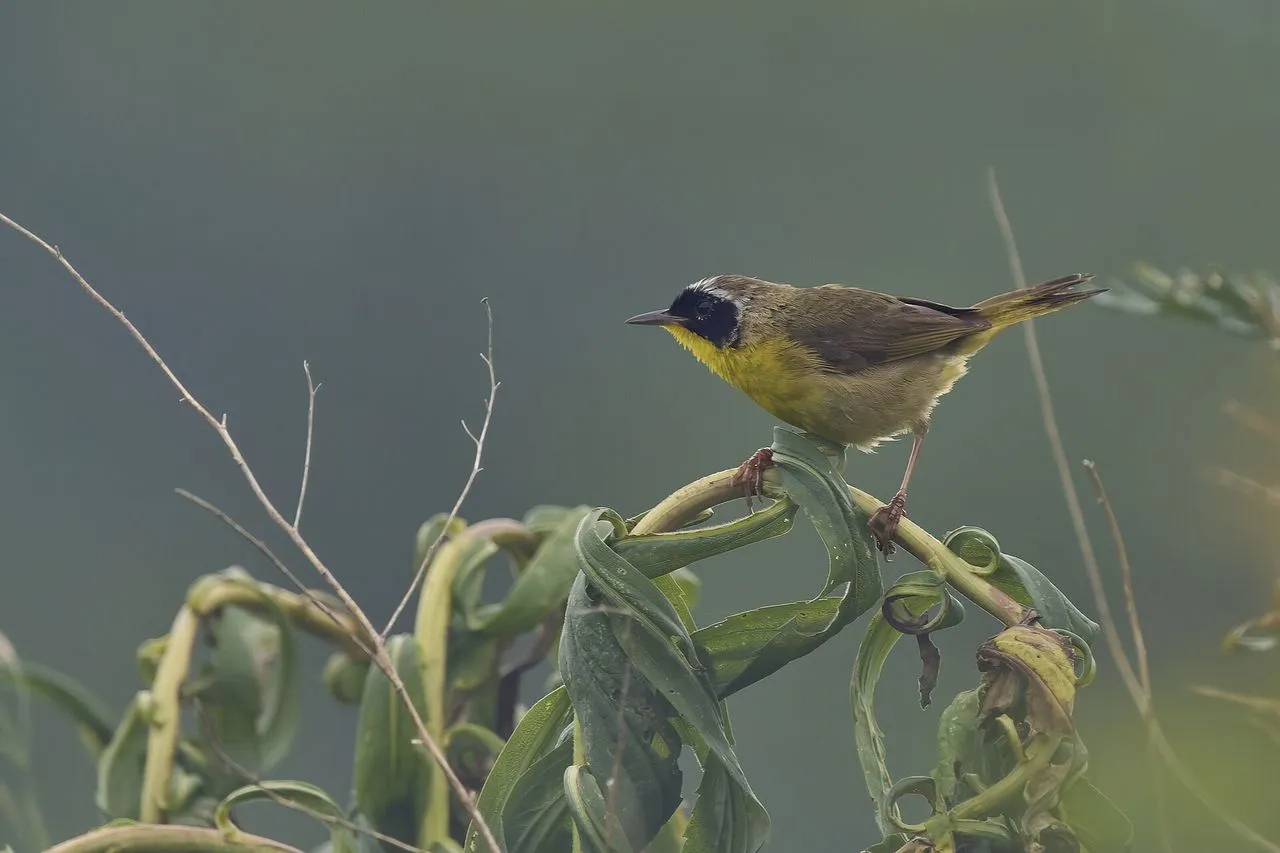
Common Yellowthroat (Geothlypis trichas) is one of North America's most abundant warblers. Males have a distinctive black 'bandit' mask with yellow throat. Found in wetlands, marshes, and scrub. Song is 'wichity-wichity-wichity'.
Geothlypis trichas is among the most abundant breeding warblers in North America, present across virtually all of the continent from southern Alaska and Nova Scotia south through the contiguous United States and into Mexico, yet consistently underdetected by observers who work primarily by sight.
Part of the Complete Warblers Guide.
Identification
The adult male is identified immediately by a broad black mask covering the lores, cheeks, and auriculars, bordered above by a white to pale grey band. Below the mask, the throat and upper breast are bright yellow; the belly is whitish to pale yellowish; the flanks are olive-buff. Back, wings, and tail are plain olive throughout.
Females carry no mask: plain olive above, with a yellow-washed throat, off-white belly, and buff flanks. Immature females are drabber still, with only a faint yellow tinge on the throat and a generally brown-olive tone, making them one of the more commonly misidentified autumn warblers.
Body length 11 to 13 cm, weight 8 to 10 g. The bill is slightly heavier than a typical parulid, moderately decurved. Rounded wings and a short tail reflect a life spent in dense horizontal vegetation rather than open canopy foraging.
Song and Calls
The advertising song is one of the most recognisable of any North American warbler: a loud, rolling wichity-wichity-wichity, typically three to five repetitions of the three-syllable phrase, with emphasis falling on the second syllable. Males sing persistently from within or just above dense marsh vegetation from April through July, often before presenting any visual target.
The call is a dry, slightly husky tchet, lower-pitched and drier than the chips of most Setophaga species, and the main acoustic cue once singing ceases in late summer. Learning this call is the single most reliable method for detecting the species during autumn migration.
Confusion Species
| Species | Key separator |
|---|---|
| MacGillivray's Warbler (Geothlypis tolmiei) | Grey hood extends to the upper breast; incomplete white crescents above and below the eye |
| Mourning Warbler (Geothlypis philadelphia) | Complete grey hood with no white border above the mask; largely eastern range |
| Nashville Warbler (Leiothlypis ruficapilla) | Bold white eye ring; no mask; yellow extending to the belly |
Distribution
Breeds across virtually all of North America below the treeline. The species is resident year-round in the southern Atlantic coastal states, Florida, and coastal California, where persistent insect availability removes the pressure to migrate. Northern and interior populations are fully migratory, wintering across Mexico, Central America, and the Caribbean, with a few birds reaching northern Colombia and Venezuela.
Up to 13 subspecies have been described, varying principally in the width and lower extent of the male's mask, the intensity of yellow on the underparts, and the general tone of the upperparts from grey-olive to warm brown.
Habitat
Dense low vegetation near water defines the habitat requirement more precisely than any other single factor. Cattail (Typha) and bulrush (Scirpus) marshes are the stereotypical setting, but wet alder scrub, rank grass with scattered low shrubs, overgrown drainage channels, and boggy bracken on moorland edges all serve. The consistent structural requirement is vegetation below about 1.5 m that provides enough horizontal stems and leaf cover to allow movement without open-air exposure.
Unlike the Yellow Warbler, Common Yellowthroats do not require woody canopy above the vegetation layer. A stand of tall cattail with no shrub cover is adequate for territory establishment. This makes the species more predictable in purely herbaceous wetland habitats where most other warblers are absent.
Diet
Almost entirely insects: caterpillars, beetles, ants, grasshoppers, and small flies, with spiders taken regularly. Foraging typically occurs within 0.5 m of the ground, the bird moving deliberately through stems and leaf litter and picking prey from surfaces rather than sallying after flying insects in the open. Berries are rarely recorded in the diet.
Breeding Biology
The nest is a bulky cup built at or just above ground level in dense vegetation, woven into the base of cattail stems or anchored in rank grass, and lined with fine plant fibres and hair. Clutch size is 3 to 5 eggs, white with brown and black spots concentrated at the larger end. Incubation runs approximately 12 days, carried out by the female; both adults provision nestlings, which fledge at 8 to 10 days.
Double-brooding is frequent across the southern portion of the range. Brown-headed Cowbird (Molothrus ater) parasitism is common throughout, though female yellowthroats show less consistent egg-burial behaviour than the Yellow Warbler does in the same situation.
Notes
Despite being one of the most abundant passerines on the continent, Common Yellowthroats are regularly missed by observers who scan rather than listen. In a cattail stand where multiple males are singing audibly, a still wait at the marsh edge, avoiding movement, will usually produce a perched view within a few minutes as a male moves to an elevated singing post above the vegetation line.
Autumn migrants use a wider range of vegetation types than breeding birds, appearing in dry scrub, overgrown field margins, and gardens with dense low cover well away from standing water. A garden with a bramble thicket or dense hedgerow base can host a migrant in September or October with no wetland habitat nearby.
See Also
- Yellow Warbler: the streaked yellow wetland warbler with the sweet-sweet-sweet song.
- Hooded Warbler: another skulking low-vegetation warbler that often flashes white tail feathers.
- Prothonotary Warbler: the bright swamp specialist that shares marshy and wooded wetland edge habitat.
- Song Sparrow: a marsh-edge singer that overlaps in cattails, scrub, and dense low cover.
- The Complete Warblers Guide: family taxonomy, identification structure, and migration timing.
Frequently Asked Questions
How do I identify Common Yellowthroat?
Male: black mask across eyes, yellow throat and chest, olive-brown upperparts. Female: plain face with yellow limited to throat and undertail. The black mask is distinctive among North American warblers.
Where does Common Yellowthroat live?
Wetlands, marshes, cattails, bogs, and shrubby areas across North America. One of the most abundant warblers, found wherever there's suitable dense low vegetation near water.
What is the Common Yellowthroat song?
'Wichity-wichity-wichity', a distinctive series of notes often given from hidden perches. Males sing from low perches in wetlands. The song is one of the most familiar sounds in marshes.
Can I attract Common Yellowthroat?
They prefer dense wetland habitat, difficult to attract to feeders. However, maintaining a brushy area near water or a small wetland on your property can host breeding pairs.