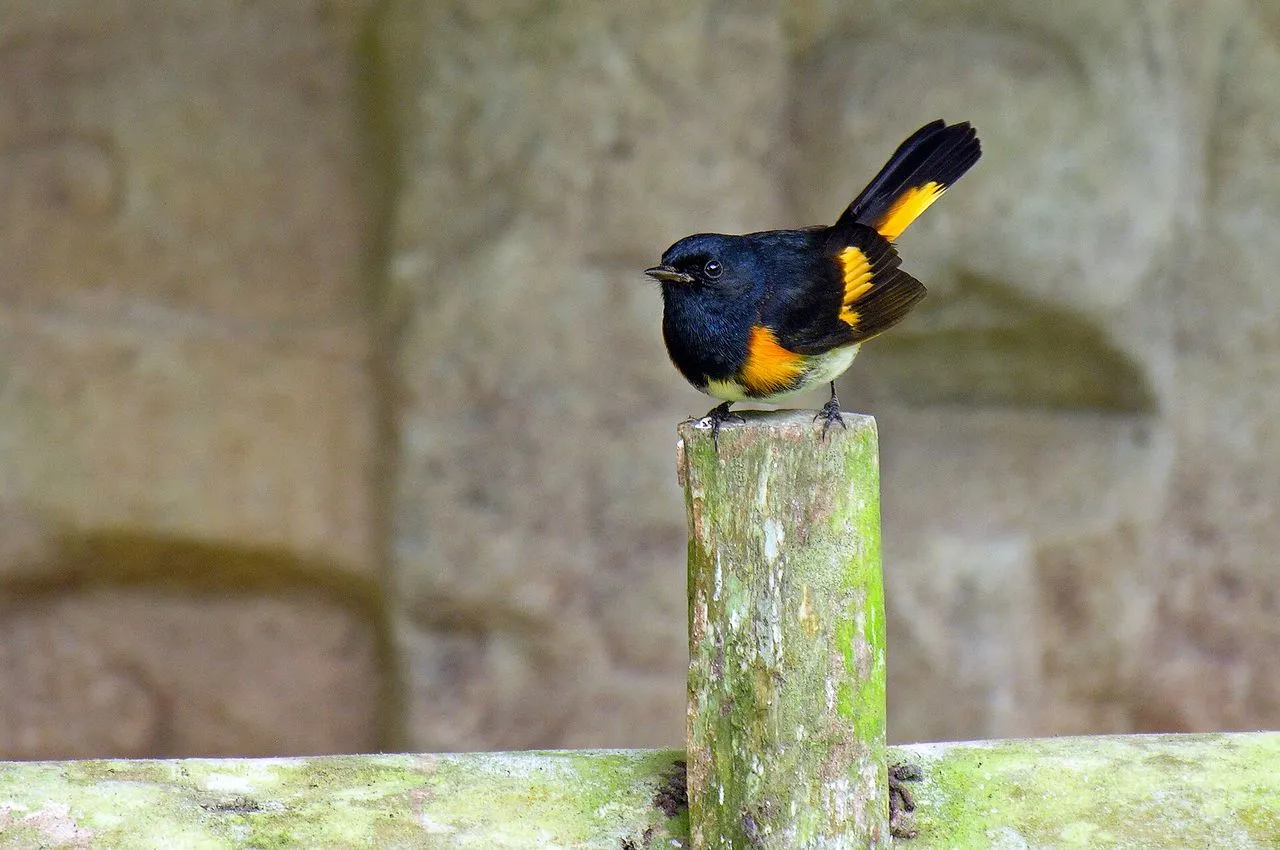
American Redstart (Setophaga ruticilla) is a warbler (11–14cm) that flashes orange/yellow tail and wing patches to flush insects. Males are black with orange patches; females are grey with yellow patches. Found in deciduous woodland.
Setophaga ruticilla Linnaeus, 1758, the American Redstart, is an 11 to 14 cm warbler of about 6 to 9 g that uses conspicuous tail and wing flashes to flush insect prey from foliage.
Part of the Complete Warblers Guide.
Identification at a glance
| Feature | American Redstart (Setophaga ruticilla) | Common confusion |
|---|---|---|
| Adult male | Black with orange wing, tail, and flank patches | Magnolia Warbler has yellow underparts and a white tail band |
| Female or immature | Olive-grey with yellow patches in the same wing and tail pattern | Female Magnolia Warbler shows wing bars and a broad white tail patch |
| Behaviour | Droops and fans tail while sallying after flushed insects | Most yellowish warblers glean without repeated tail-fanning |
| Size | 11 to 14 cm (4.3 to 5.5 in), 6 to 9 g (0.2 to 0.3 oz) | Similar-sized warblers lack the flashing tail pattern |
| Primary habitat | Deciduous woodland, second growth, riparian forest | Open marsh warblers stay lower and do not fan the tail this way |
Identification
Visual
Adult males are black with vivid orange patches on the wings, tail, and flanks and a white lower belly. The tail is long for a warbler and frequently fanned. When the bird pivots through foliage, the orange tail bases open and close like signal flags. Females and immature males replace black with olive-grey and orange with yellow, but they retain the same patterned tail, wing patches, and active fanning behaviour.
First-year males often resemble females but may show scattered black feathers on the head or breast. Full adult male plumage is usually not reached until the second year. This delayed plumage maturation matters in spring, when a singing male in female-like plumage may still hold territory. The combination of drooped wings, fanned tail, lateral hops, and sudden sallies separates redstarts from less theatrical yellowish warblers.
Audio
Song is variable but commonly a rapid series of high notes ending either abruptly or with an accented terminal phrase: see-see-see-see-see or see-see-see-see-suh. Individual males often use more than one song type, switching between repeat-mode songs directed at mates and more variable songs used in territorial interactions.
Calls include a sharp chip and softer contact notes. In dense second growth the song can draw attention to a bird that remains visually obscured, but the flashing tail usually confirms identity within seconds once movement is detected.
Distribution
American Redstarts breed across much of eastern and northern North America, from British Columbia and the Mackenzie region east across the boreal forest to Newfoundland, south through the Great Lakes, New England, Appalachians, and parts of the central and eastern United States. They are less widespread in the Great Plains and absent as breeders from most arid western regions.
Spring migrants reach the Gulf Coast in April and move through the eastern United States from late April through May. Northern breeding territories fill in late May and early June. Autumn migration begins in August and continues through October. Winter range extends through Mexico, Central America, the Caribbean, and northern South America. Habitat quality on wintering grounds influences spring arrival condition and subsequent breeding performance, a relationship documented more clearly in this species than in many warblers.
Habitat
Breeding habitat includes moist deciduous woodland, mixed forest, riparian corridors, young second-growth forest, regenerating clearcuts, wooded swamps, and forest edges. The species often favours complex midstory structure rather than closed uniform canopy. In northern forests, territories occur in aspen, birch, maple, alder, and mixed conifer-hardwood stands.
During migration redstarts use parks, gardens, coastal thickets, and any wooded edge with active insects. On wintering grounds they occupy mangroves, shade coffee, second growth, and broadleaf forest, often segregating by age and sex. Adult males tend to dominate wetter, higher-quality habitats, while females and young males are displaced more often into drier scrub.
Diet and Foraging
The diet consists mainly of small flying and foliage-dwelling insects: flies, moths, beetles, leafhoppers, caterpillars, wasps, and spiders. Redstarts forage by a distinctive flush-pursuit method. The bird spreads tail and wings, startles prey into movement, then snaps it from the air or a nearby leaf surface. This is active visual manipulation of prey behaviour, not ornamental display.
Foraging height ranges from low shrubs to upper canopy, but many birds work the midstory. They make short sallies, hover briefly at leaf clusters, and return to nearby perches. Fruit is taken occasionally in late summer and on wintering grounds, but insects dominate whenever available.
Breeding Biology
Males arrive first and defend territories with song and chase displays. Females choose nest sites in shrubs or saplings, commonly 1 to 9 m above ground in a fork of maple, birch, alder, beech, or similar deciduous growth. The nest is a compact cup of grasses, bark strips, plant fibres, and spider silk, lined with fine material.
Clutch size is usually 3 to 5 eggs. Incubation lasts about 11 to 12 days, performed by the female. Both parents feed nestlings, which fledge at roughly 8 to 9 days. Males may be polygynous where habitat quality permits, holding more than one female on or near a territory. Brown-headed Cowbird parasitism occurs, particularly near edges and in fragmented habitat.
Notes
The redstart's tail flashing is one of the clearest examples of a warbler using plumage as a foraging tool. Experiments and field observations support the interpretation that the flashes flush insects, increasing capture opportunities. The behaviour also makes the species unusually detectable: in a leafy May woodland, a redstart often appears first as a flicker of orange or yellow before the bird's body is resolved.
See Also
- Black-and-white Warbler: another active forager in second-growth and deciduous woodland, sharing the species' spring migration window.
- Hooded Warbler: the masked stream-bank warbler that uses similar dense shrub habitats in the south-eastern United States.
- Blackburnian Warbler: the boreal canopy specialist whose overlapping breeding range makes May song encounters common.
- Pine Warbler: the pine woodland parulid that also ventures to feeders and shares the redstart's seed tolerance.
- The Complete Warblers Guide: full family reference: taxonomy, migration, and identification structure.
Frequently Asked Questions
How do I identify American Redstart?
Male: black with orange patches on wings, tail, and sides of breast. Female: greyish-olive above, yellow below, yellow patches in same pattern as male. The tail-flashing is distinctive.
Why does Redstart flash its tail?
Tail-flashing flushes hidden insects, the bright patches startle prey into moving. This unique foraging method allows them to catch insects other warblers miss. Both sexes use this technique.
Where does American Redstart breed?
Deciduous and mixed forests across Canada and the eastern US. Found in second-growth and mature forest edges. Often near water. One of the most common eastern warblers.
What is the Redstart song?
A series of high notes: 'see-a see-a see-a tcher'. Relatively simple compared to many warblers. Sings from mid-level perches in forest.