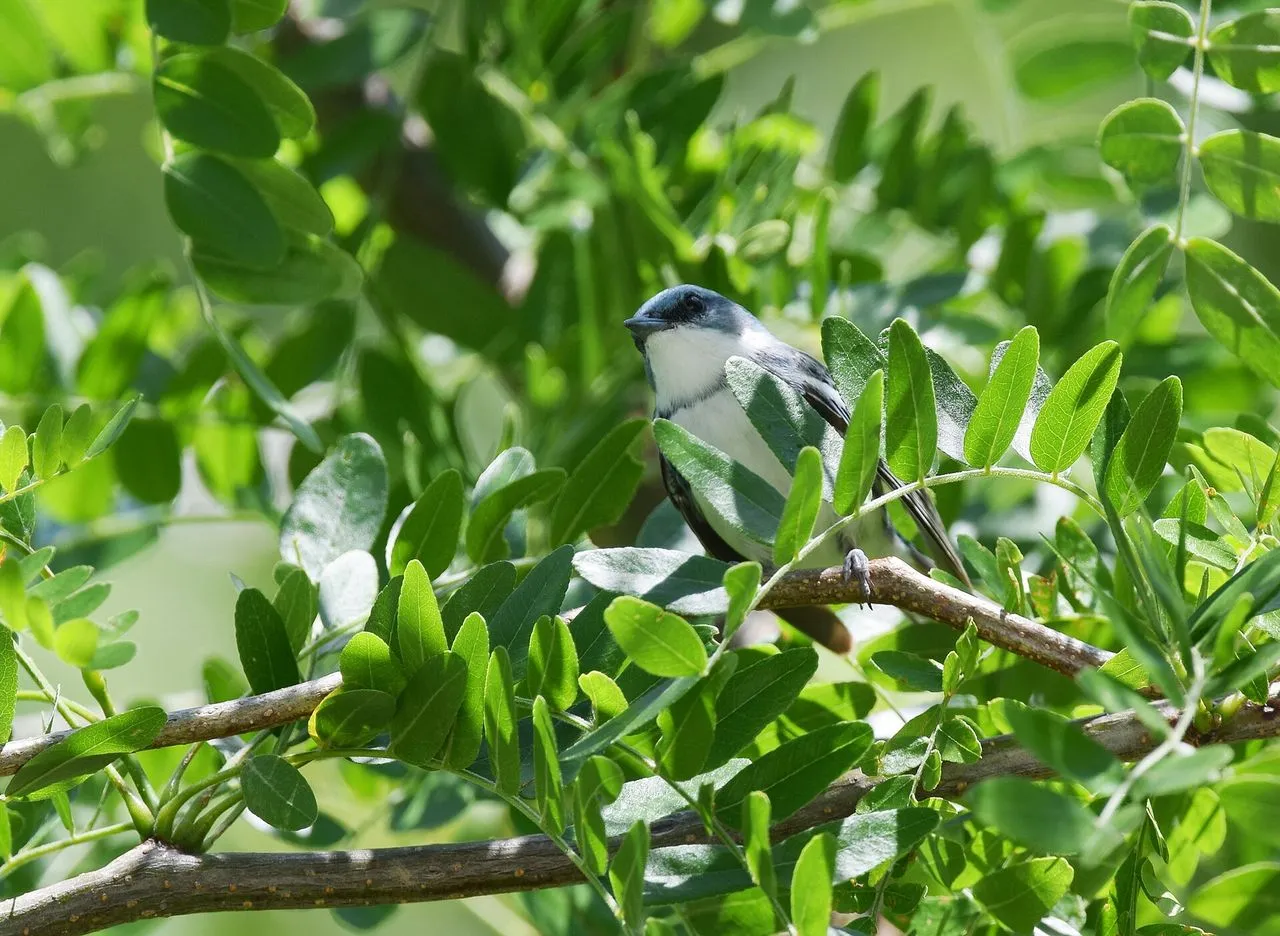
Setophaga cerulea Wilson, 1810, the Cerulean Warbler, is an 11 to 12 cm canopy warbler of roughly 8 to 10 g that has declined steeply since the mid-20th century across much of its eastern North American range.
Part of the Complete Warblers Guide.
Identification at a glance
| Feature | Cerulean Warbler (Setophaga cerulea) | Key separator |
|---|---|---|
| Adult male | Pale sky-blue above, white below, narrow blue breast band | Small and high in mature hardwood canopy |
| Female | Blue-green to olive above, whitish to yellowish below | Whitish eyebrow and wing bars help in poor views |
| Song | Buzzy ascending zee-zee-zee-zizizizi-zeet | Short, rising, and usually from canopy height |
| Size | 11 to 12 cm (4.3 to 4.7 in), 8 to 10 g (0.3 to 0.4 oz) | Smaller and paler than many canopy warblers |
| Primary habitat | Mature deciduous forest with tall, broken canopy | Not a young-spruce or low-shrub specialist |
Identification
Visual
Adult males are pale sky-blue above with black streaking, white below with a narrow blue breast band or necklace, white wing bars, and a pale face. Females are blue-green to olive above, whitish to yellowish below, with a whitish eyebrow, faint streaking, and wing bars. Both sexes are small, short-tailed, and usually high in the canopy.
The main identification problem is not confusion at close range but obtaining a view. Cerulean Warblers forage and sing in mature deciduous canopy, often 20 m or more above ground. From below, males can appear mostly white with a bluish wash, while females may resemble other greenish warblers. The combination of small size, white wing bars, pale underparts, canopy position, and buzzy rising song is often needed.
Audio
The song is a buzzy ascending phrase, commonly rendered zee-zee-zee-zizizizi-zeet, with a rising terminal note. It is short, high, and easily lost among canopy leaves. Males sing from exposed or semi-exposed high branches in May and June.
Calls are thin chips and high contact notes. During migration, when birds may descend into lower foliage, voice is less frequently heard; visual attention to wing bars and pale blue-green upperparts becomes more important.
Distribution
The breeding range is centred in the eastern United States, especially the Ohio and Mississippi River valleys, the Cumberland Plateau, Appalachians, and scattered mature forest regions from the Great Lakes south to the Gulf-state uplands. It reaches southern Ontario locally and has become scarce or absent in some former breeding areas.
Spring migration passes through the Gulf region and eastern states mainly from April into May. Autumn migration begins as early as July for some adults and continues through September, but the species can be inconspicuous. Winter range lies on the eastern slope of the Andes from Venezuela and Colombia through Ecuador, Peru, and Bolivia, where it uses montane forest and shade-grown plantations.
Habitat
Breeding habitat is mature deciduous forest with tall canopy, large trees, broken crowns, and complex vertical structure. Cerulean Warblers often occur on slopes, ridge benches, riparian bluffs, and mature bottomland forest where canopy gaps create foraging edges high above ground. Oak, hickory, maple, sycamore, tulip tree, and other large hardwoods are used depending on region.
Simple forest age is not enough. A pole-stage stand may be closed-canopy but unsuitable because it lacks large limbs and canopy heterogeneity. Conversely, selective harvest that retains large trees and creates small gaps can sometimes maintain territory structure, though heavy fragmentation and removal of mature canopy are harmful.
Diet and Foraging
Diet consists of caterpillars, beetles, flies, leafhoppers, scale insects, and spiders. Cerulean Warblers glean from leaf clusters and small branches in the upper canopy, moving quickly along horizontal limbs and occasionally hovering. They exploit the sunlit outer portions of broadleaf crowns where caterpillar and leafhopper densities can be high.
Foraging height is one reason detection is difficult. Birds may remain directly above an observer for minutes, obscured by leaves, while small prey captures continue unseen. During migration they feed lower in woodland edges, where the pale blue or green upperparts become more apparent.
Breeding Biology
Females build nests high in deciduous trees, often 10 to 20 m above ground on a horizontal limb. The nest is a small cup of bark strips, grasses, spider silk, and plant fibres, sometimes decorated externally with lichens or bark. Placement near canopy gaps or outer limbs is common.
Clutch size is usually 3 or 4 eggs. Incubation lasts about 11 to 13 days, performed by the female. Both adults feed nestlings, which fledge at roughly 9 to 11 days. Cowbird parasitism and nest predation increase in fragmented landscapes. Because nests are high, direct monitoring is difficult, and population assessment relies heavily on singing males.
Notes
Cerulean Warbler decline reflects pressures across the annual cycle: loss and fragmentation of mature eastern hardwood forest, altered canopy structure, and deforestation in Andean wintering areas. The species demonstrates why a warbler can be locally present yet regionally insecure. A singing male in a tall oak does not mean the landscape is healthy if surrounding forest is too fragmented to support enough successful nesting territories.
See Also
- Blackburnian Warbler: the boreal canopy warbler that shares the cerulean's high-foraging zone and similar song frequencies.
- Magnolia Warbler: the boreal breeding neighbour with the distinctive tail pattern; both occupy canopy zones.
- Black-and-white Warbler: the bark-creeping parulid of mature eastern forest, sharing the cerulean's Appalachian range.
- Ovenbird: the ground-nesting warbler of mature eastern forest interior, sharing the same breeding habitat.
- The Complete Warblers Guide: full family reference: taxonomy, migration, and identification structure.
Frequently Asked Questions
How do I identify Cerulean Warbler?
Adult males are pale sky-blue above with black streaking, white below with a narrow blue breast band, white wing bars, and pale face. Females are blue-green to olive above, whitish to yellowish below, with a whitish eyebrow. Small size, white wing bars, and canopy position are key. Views are often difficult due to the bird's height.
Why is Cerulean Warbler in decline?
Faces pressures across its entire annual cycle: loss and fragmentation of mature eastern hardwood forest, altered canopy structure, and deforestation of Andean wintering grounds in the Andes from Venezuela through Peru and Bolivia. The species requires large, mature forest blocks to maintain viable populations.
Where does Cerulean Warbler breed?
Mature deciduous forest with tall canopy, large trees, and complex vertical structure in the Ohio and Mississippi River valleys, Cumberland Plateau, Appalachians, and mature forest regions from the Great Lakes south to Gulf-state uplands. Reaches southern Ontario locally. Simple forest age is not enough, needs large limbs and canopy heterogeneity.
How does Cerulean Warbler song sound?
A buzzy ascending phrase: 'zee-zee-zee-zizizizi-zeet', with a rising terminal note. It is short, high, and easily lost among canopy leaves. Males sing from exposed or semi-exposed high branches in May and June.
Sources & References
- Ehrlich, P.R., Dobkin, D.S. & Wheye, D. (1988). The Birders Handbook. Simon & Schuster.
- Cornell Lab of Ornithology. (2024). All About Birds: Cerulean Warbler. birds.cornell.edu
- Sibley, D.A. (2014). The Sibley Guide to Birds (2nd ed.). Knopf.
- Kaufman, K. (1996). Birds of North America. Houghton Mifflin.